
Shared mailbox best practices are a set of rules and processes that help teams manage a shared inbox efficiently.
As customer service teams grow and email volume increases, communication becomes harder to manage without structure. A shared mailbox helps teams stay organised, improve accountability, and respond faster.
These practices solve issues like unclear ownership, missed messages, duplicate replies, inbox clutter, and inconsistent responses. This slows customer support and affects service quality.
Therefore, it’s important to adopt shared mailbox best practices early to prevent delays and missed messages.
51% of consumers believe email is the most effective and convenient method for companies to communicate with them. This making shared mailbox management essential for any customer-facing team
If you plan to use a shared mailbox or are already using one, you’re in luck! In this post, we share our top 5 shared mailboxes best practices that can help your business
Let’s dive in.
A shared team inbox is a single mailbox that multiple team members can access and use to manage messages together. It ensures key messages are never missed and keeps everyone aligned on what has been replied to and what hasn’t.
Common examples of shared inboxes include:
Shared inboxes give your entire team visibility over every incoming message in one place. Instead of emails sitting in individual inboxes, everyone can see what has come in, what has been answered, and what still needs attention.
This breaks down siloed communication and means teams can collaborate on customer issues faster, without chasing each other for updates or context.
In our experience, the two areas where businesses benefit most from shared mailbox best practices are customer service and sales operations.
A shared mailbox gives your customer support team one place to receive, assign, and respond to queries. This means faster response times, no missed messages, and clear ownership of every conversation.
According to a Microsoft survey, 90% of people say customer service directly influences their choice of, and loyalty to, a brand. A shared mailbox makes it easier to stay on top of every query and keep your customers satisfied.
A shared mailbox ensures inbound sales leads never go unanswered, even when individual reps are unavailable. Speed of response is one of the biggest factors in whether a lead converts.
If leads are directed to an individual’s inbox while the sales reps is off, they are left waiting. Doing that regularly will lead to fewer conversations and fewer closed deals.
However, if you regularly leave sales leads waiting, you’ll have fewer conversations and close fewer deals. The data backs this up.
As Salesloft research found, responding to a sales lead within 2 minutes maximizes the chance of booking a meeting. Waiting 5 minutes increases the risk of losing the lead tenfold, while a 10-minute delay raises that risk by 100x.
In essence, the speed of response outweighs both time of day and the day of the week in its effect on contact and qualification ratios for sales teams.
Ensuring your team has a system to quickly engage with your sales leads is key to business success. In the next section, we dig into some crucial shared mailbox best practices to help you and your team excel.
Also Read:
The five shared mailbox best practices that make the biggest difference are setting clear processes, assigning ownership, preventing duplicate replies, tracking performance, and using the right tools.
Following a few key shared mailbox best practices can help your team stay organised, respond faster, and never let an important email slip through the cracks.
Clear processes ensure every team member knows who is responsible for what, which reduces confusion, improves accountability, and keeps response quality consistent across the team.
The first step is to talk to your customer-facing teams to identify their repetitive and time-consuming daily tasks. With a clear view of this, you can create processes and systems to speed up their workflow by:
For example, if your customer-facing teams are sending near-identical emails to prospects, one of the top shared mailbox best practices is to add those email templates to a shared knowledge base or as a keyboard shortcut.
Key assets such as sales decks or customer service resources should also be stored in one centralised place. This guarantees that whenever your sales team needs to send a new deck to a potential client, they know exactly where to find it and that it is up to date.
A rota system ensures the inbox is always covered by a designated person. It ensures emails get answered promptly without pulling the entire team away from other work.
If your team checks their emails all day, nothing will get done (apart from email management!).
We’re big advocates of using email productively, but it shouldn’t be at the expense of other targets and KPIs.
One of the simplest shared mailbox best practices is to implement a rota system to check it.
For example, if you have a team of ten customer support reps, it wouldn’t make sense to have all ten monitoring the inbox simultaneously. After all, when a new inquiry lands in your inbox, they can’t all reply at the same time.
You can use a simple rota system to assign one or two members of your team to be responsible for your shared inbox at different intervals throughout the day. They’ll be focused on staying responsive while they’re managing your inbox, and the rest of your team can focus on other business tasks.
This way, you streamline email productivity without compromising overall team goals. It’s also one of the shared mailbox best practices that scales well as your team grows.
Running a weekly inbox review keeps your team aligned, helps surface missed emails, and ensures your inbox management processes keep improving
At the end of every week, sit down with your team to review your inbox and inbox management practices.
Ask your team questions like:
Trust your team’s insights and work with them to improve inbox management, and over time, you can ensure your team is set up for success.
During this weekly review, you can use reports generated by shared mailbox reporting software like timetoreply to identify if there were:
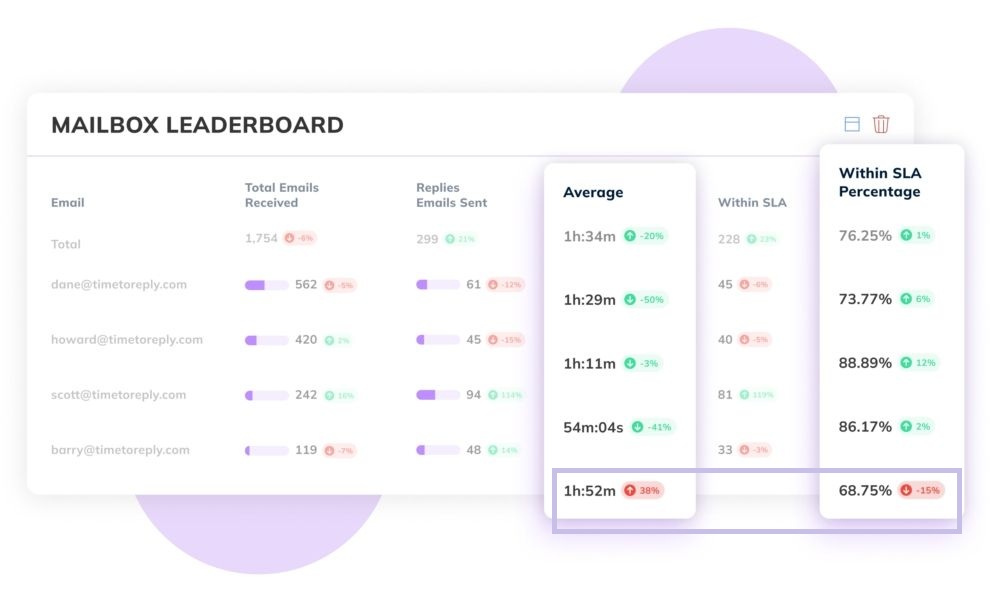
Image via timetoreply
Both are incredibly valuable. The former can be used to improve your preparation for such moments in the future so that your customer support team isn’t overwhelmed. And the latter gives you an opportunity to work with and support your team.
Also Read:
Internal notes help teams keep customer information organized and accessible across conversations. They also reduce delays by giving team members the context they need before replying.
As your customer base grows, it can be alarmingly easy to lose track of individual conversations with clients.
The consequence of that is potentially losing key information. That means in the future you may need to ask clients or leads questions they’ve already answered, which isn’t a great look.
Or you may have to turn to your team for information, which will slow your reply time and leave your clients or leads wondering why you’re taking so long to get back to them.
To avoid this, log every essential client interaction so other team members can quickly jump into conversations in your shared mailbox.
This is one of the core shared mailbox best practices that ensures continuity and transparency across your support or sales teams.
These notes can be saved in your CRM system, like Salesforce or HubSpot, making it easy for anyone on your team to access them.
When your customer-facing teams are talking to a customer or prospects, they’ll know all of the critical details of past interactions and can surface them as and when needed.
It’ll also speed up the time it takes for agents to reply to customers, as they won’t need to jump into your customer service Slack channel or send emails to other team members to find out the information they need to do their job.
You can measure shared mailbox performance by tracking response speed, unresolved emails, and team workload distribution.
If your email performance is a priority, then you need an effective way to measure and manage it. Then you can optimize how you’re using your email accounts to communicate with your team, clients, and leads.
Shared mailbox reporting software like timetoreply helps customer service teams identify delays, improve efficiency, and improve your team’s email productivity.
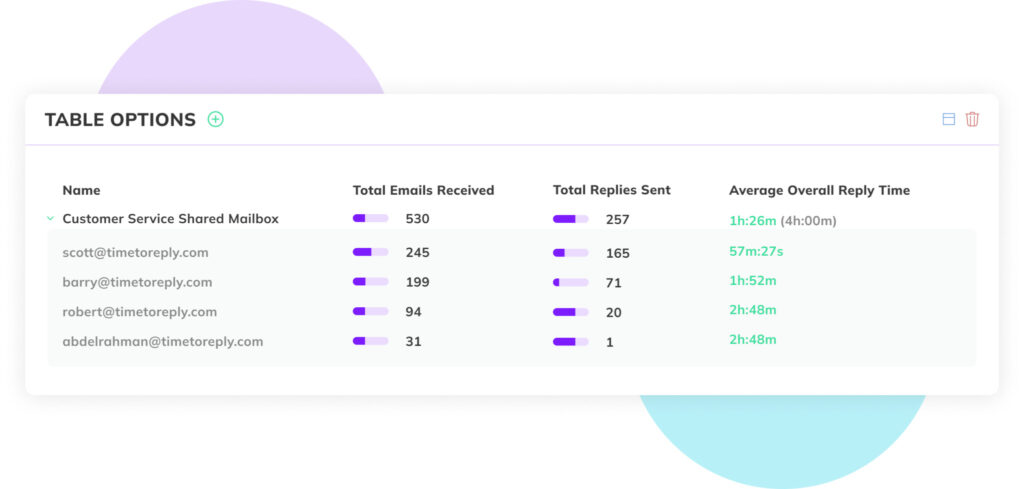
Image via timetoreply
It also easily connects to your teams’ inboxes, whether it’s Gmail or Outlook, to share data on key email metrics such as:
From there, you can use your insights to address staffing problems, improve your email rota, and have the visibility needed to improve your team’s email productivity and performance.
Also Read:
Common shared mailbox challenges include unclear ownership, poor visibility, disorganised threads, inconsistent messaging, and delayed response times. These can be overcome by using clear processes and shared inbox tools with proper assignment, tracking, and organisation features.
Here are some major challenges
Also Read:
Teams scale shared mailbox workflows by putting clear structure in place as email volume grows. Clear roles ensure every message has an owner, even in larger teams.
Here are key practices help maintain control and efficiency:
Also Read:
1. How do you manage a shared mailbox effectively?
Start with clear shared mailbox best practices like defining roles, creating standardized replies, and implementing tagging systems.
Set up automation for sorting and prioritizing messages, and assign team members to specific time slots to prevent delays or duplication. Use internal notes to ensure context is preserved across shifts.
2. What are the limitations of a shared mailbox?
While shared mailbox best practices minimize many challenges, several limitations exist. The most significant is potential message confusion when multiple team members access the same inbox simultaneously. Additionally:
Implementing clear guidelines, using a rota system, and integrating email management tools can mitigate these risks.
3. What are the benefits of a shared mailbox?
Implementing shared mailbox best practices delivers numerous advantages. The primary benefit is improved collaboration through centralized communication. Teams have access to a single inbox, ensuring no query is missed.
This supports better response times, continuity of service, and easier collaboration. Shared mailboxes also reduce the need for constant forwarding or CCing and simplify internal workflows.
Additionally, there’s better transparency and more effective knowledge sharing since team members can view previous interactions and customer history.
4. How can you properly monitor a shared mailbox?
Effective monitoring of a shared mailbox requires regular inbox audits, which means setting up a system to track unread or unresolved emails. You want to:
Regular reviews, activity logs, and tagging systems help maintain transparency and ensure shared mailbox best practices are being followed.
5. How do you tell if a mailbox is a shared mailbox?
A shared mailbox usually lacks a personal identity and is designed for group access. Look for signs such as multiple users managing the inbox, the absence of an individual sender name, and a generic email address (e.g., support@company.com).
In Microsoft 365 or Google Workspace, admins can confirm this in the admin console under mailbox permissions or group settings. In Outlook, administrators often set up shared mailboxes without individual login credentials, meaning users access them through their own email accounts, rather than separate login details.
6. How do you prevent duplicate replies in a shared mailbox?
Use email assignment to ensure only one person owns each conversation. Clear ownership reduces duplicate responses and customer confusion. Status labels like “in progress” or “resolved” also help.
7. What tools improve shared mailbox performance?
Shared mailbox tools improve workflow through automation and tracking features. They support assignment, tagging, analytics, and internal collaboration notes. These features improve response speed and reduce manual coordination.
8. Why is visibility important in a shared mailbox?
Visibility ensures everyone can see conversation history and current status. It reduces miscommunication between team members. It also helps teams respond faster with full context available.
Also Read:
Shared inboxes work best when clear processes and structured ownership guide customer communication.
The most effective shared mailbox best practices include clear responsibilities, organized workflows, and duplicate-reply prevention. They also include performance tracking and visibility into all customer conversations across the team.
Shared mailbox software helps teams manage these processes in one place and improves coordination. Features like conversation assignment, reply tracking, analytics, and shared visibility reduce confusion and enable faster response times.
This leads to fewer missed messages and more reliable customer support outcomes.
Ready to improve the way your team manages shared inboxes? Schedule a demo to see how shared mailbox software can improve your team’s email performance.
Get live inbox alerts and reply quickly to customer emails with timetoreply

Head of Customer Success @ timetoreply
Barry Blassoples is the Head of Customer Success at timetoreply, where he helps customer-facing teams boost revenue and protect brand reputation by providing actionable insights to improve their business email response times. He has over 15 years of leadership experience across customer success, sales, and marketing roles in high-growth tech companies.



Trusted by high-performing inbound sales teams and customer-facing teams globally.
Close more deals and delight more customers with the faster, smarter, deeper email analytics and performance optimization software that works straight from your team’s inbox.