
To improve response times, businesses implement clear response time targets, prioritize urgent customer queries, and use automation tools like email response management software. This tracks your SLA compliance and gives you real-time alerts so customer queries aren’t missed.
Slow responses reduce customer satisfaction, damage brand trust and increase churn. Delayed responses tell customers that their needs may not be a priority. This pushes them to look for other alternatives, like your competitors that may provide faster responses.
Additionally, customers who feel ignored can leave negative reviews on social media and review sites. This can lead to more people viewing your brand as poorly organized.
Customers who get delayed responses may reach out to your support teams multiple times, and via different channels like email, social media, and live chat on your website. This may create duplicate tickets which increases the workload on your support team which further delays response times.
In this article, we’ll analyse the impact of response time on customer satisfaction and strategies to improve response times to increase customer loyalty and drive repeat purchases. You’ll also learn how technology can automate team performance tracking and give you real-time alerts so no customer request is missed or delayed.
Customer-facing excellence is a strategy used to deliver a helpful experience to customers whenever they interact with your business. This can be through support emails, live chat, phone calls, onboarding, or sales conversations.
It focuses on responding quickly, solving problems clearly to avoid follow-ups, and making customers feel valued instead of ignored.
To achieve this, you should focus on core pillars:

The impact of response time on customer satisfaction is analyzed by understanding the role of response time in customer service and the cost of slow response times. It also includes breaking down how fast response times increase customer loyalty and lead to a positive brand perception.
The role of response time in customer service means that how fast a company replies to customers directly affects the quality of the service experience. Fast and efficient responses are the key to creating a positive impact of resins time on customer satisfaction. 29% of consumers say they have stopped using a brand due to poor customer experience, according to PwC. A poor customer experience can be caused by situations where customers feel ignored, such as receiving slow replies.
It can also be caused when support is hard to reach or customers have to repeat the same problem multiple times. To avoid this, you should invest in fast and effective customer support teams and train them on how to write customer service emails that help resolve issues before they escalate.
Slow response times can lead to customer frustration, negative reviews, and eventually, customer churn.
The impact of response time on customer satisfaction is noticeable. Customers often feel ignored or undervalued when businesses take too long to respond. This means they’ll switch to a competitor who replies faster which leads to lost revenue.
Today, customers expect businesses to reply quickly across all communication channels. In fact, according to Zendesk, 74% of customers now expect customer service to be available 24/7, especially with the introduction of AI agents. 88% of customers also expect faster response times than they did last year.
This reinforces the importance of improving response times and delivering outstanding customer service.
Also Read:
Fast reply times increase customer loyalty and trust because customers feel your business is reliable and willing to help them quickly when issues arise. Over time, this positive experience strengthens trust and makes customers more likely to renew their subscriptions instead of switching to competitors.
In fact, according to Freshworks, first response times dropped from six hours to four minutes in 2025. Resolution time also reduces to 32 minutes instead of 32 hours. This led to customer satisfaction increasing from 89% to 99%. Businesses also align with customer expectations for timely support.
Higher customer satisfaction drives customer loyalty which helps increase revenue in the long-term.
Rapid responses show a business’s commitment to customer satisfaction, which customers interpret as a sign of reliability and professionalism.
This creates a simple chain reaction in the customer’s mind. A fast reply makes them feel heard, which makes them more comfortable dealing with the brand again. Over time, these repeated experiences build brand sentiment, meaning customers start saying things like “they always respond quickly” or “they actually take care of issues.”
That sentiment then turns into brand perception, where the customer forms a stable opinion that the brand is reliable, responsive, and easy to deal with. This improves customer retention and increases revenue.
Also Read:
You need to set clear response time targets, systems for prioritizing urgent issues, and automation for routine requests. You also need well-trained support teams, customer feedback analysis, and tools that track your support team’s response performance across channels:
Efficient systems for faster customer service satisfaction rely on automation, omnichannel support, and well-trained customer support teams. Focus on providing self-service options and real-time AI answers for tier-one queries. These are first-level support requests that involve common issues such as password resets that AI can usually resolve:
Also Read:
Fast and effective customer interactions directly impact key performance indicators such as customer satisfaction, loyalty, and overall brand perception.
Timely responses foster positive customer experiences and contribute to increased customer retention rates, higher customer lifetime value, and enhanced word-of-mouth referrals. This shows the importance of quick responses to customers.
This helps you stand out against competitors and increases revenue in the long-term.
Improved response times increase sales by fostering a positive customer experience, building trust and reducing frustration. It also facilitates faster decision-making when customers compare you with competitors.
In fact, when it comes to sales inquiries, the longer your response time, the less likely you are to close deals. Under five-minute response times shows customers that you value them, leading to a 32% close rate. This is compared to 12% close rate for over 24 response time:
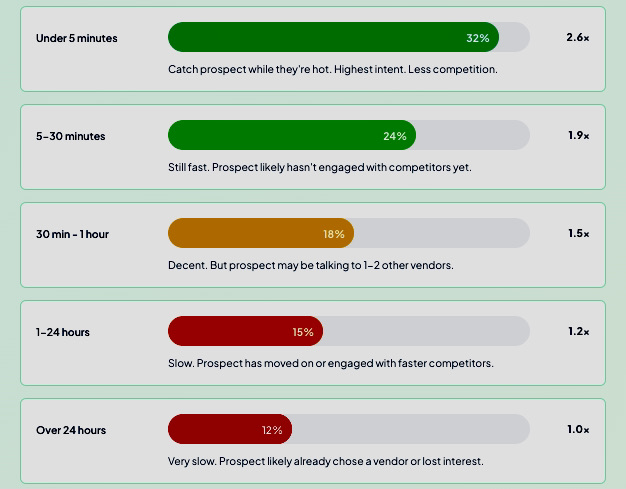
Image via Optifai
Efficient customer service not only contributes to customer retention but also generates positive word-of-mouth. When customers are spreading the word about exceptional service experiences, they become valuable advocates. This amplifies your business’s reputation and attracts new customers through authentic recommendations.
By leveraging the positive impact of response time on customer satisfaction, your business can increase sales potential.
Also Read:
You can use technology like email response management software that improves email performance by reducing reply times and ensuring teams meet email reply time SLA (Service Level Agreement) goals. These SLAs are defined response time targets (for example, replying within 4 hours) that teams are expected to consistently meet.
Efficient support teams with 42% first response SLA compliance achieve near 100% customer satisfaction, while slower teams with 3% compliance see only 63.7% satisfaction:
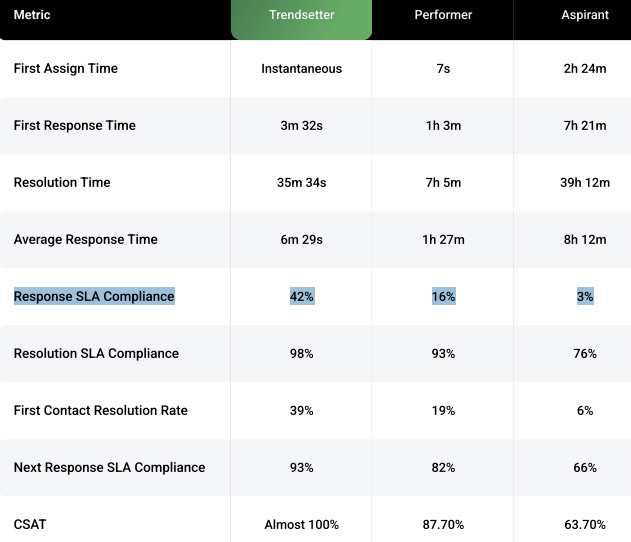
Image via Freshworks
You can track SLA compliance in timetoreply email response management software:
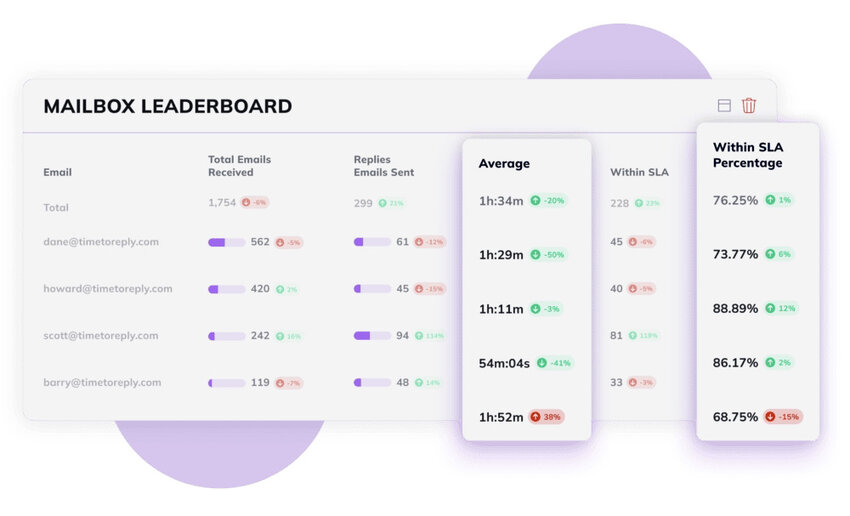
Image via timetoreply
This tool also provides real-time alerts so important customer emails are not missed.
This includes the use of technologies like AI and automated workflows to speed up how businesses manage and respond to customer emails and support requests.
For example, with tools like timetoreply, teams gain real-time visibility of incoming emails, can track response performance against SLA targets, and quickly identify which messages need immediate attention.
This reduces manual tracking, prevents missed or duplicated replies, and helps support teams respond to customers more efficiently.

Tools like timetorpely help improve response time and efficiency by automating email tracking, giving real-time visibility of customer requests, and helping support teams prioritize urgent issues and respond faster.
For example, Muve relied heavily on manual processes to keep track of customer requests. Account managers would take notes on incoming calls then have to sign-off and ensure customers receive the help they needed.
This can result in delayed email response times which reduces customer satisfaction. Muve started using timetoreply Success to automate manual processes like capturing customer data, SLA tracking, and reporting. Watch this short video on how to use timetoreply Success:
Video Via YouTube
Now Muve can make sure only one person responds to customer support requests but everyone on the team has a real view of the status of requests. Everyone can ensure that customer requests are responded to quickly.
This is why Suren Nanayakkara, Muve’s ICT Director, calls timetoreply a “game-changer.”
Also Read:
1. How does system response time affect user satisfaction?
System response time affects user satisfaction because it determines how long users have to wait after performing an action (like clicking a button or submitting a form) on a website or app. Faster response times increase customer satisfaction. The impact of response time on customer satisfaction becomes evident when platforms are slow to load or respond. It frustrates customers and erodes their trust.
2. How does responsiveness affect customer satisfaction?
Responsiveness is how quickly and consistently a business responds to customer questions, requests, or issues. Customer satisfaction increases when they receive fast, clear, and helpful replies that resolve their problems efficiently. It reduces satisfaction when responses are slow, unclear, or fail to fully address their issues.
3. How can you be more responsive to customers?
To improve responsiveness, you can implement a multi-faceted approach:
4. How does wait time impact customer satisfaction?
Delays in response or resolution times make customers feel undervalued. Quick responses, on the other hand, show customers that you value their time and care about their needs.
The impact of response time on customer satisfaction cannot be overemphasized. Minimizing wait time creates a smoother, more efficient experience. It boosts satisfaction which increases retention as they won’t feel the need to move to competitors.
5. What is the difference between response and responsiveness?
Response refers to the act of replying to a customer inquiry. Meanwhile, responsiveness encompasses the reply’s speed, quality, and consistency across communication channels.
A response is measured by metrics like “first response time” or “resolution time” for individual cases. Exceptional customer service requires excellence in both areas — fast personal replies supported by a responsive team or system.
6. How does response time affect customer loyalty?
Customers are more likely to remain loyal to your brand if you provide fast response times. This is because faster response times reduce stress and escalation of the same request to different customer agents. It helps customers feel confidence that help is available when needed, even in the future.
7. Do live agents resolve customer support requests faster than AI?
It depends. Live customer support agents understand customer intent, especially for complex issues such as payment failures.AI can handle simple requests like password resets or acknowledge complex issues until an agent is available, improving first response times and customer satisfaction.
8. Do different channels have an impact on customer service response times?
Yes. For example, live chats and social media should have immediate or quick response times. This can be within minutes to an hour. Phone calls should also provide immediate response, while wait times should only vary depending on the complexity of the issue. Emails are usually answered in around one day.
Also Read:
Faster responses improve trust, loyalty, and overall customer experience while slow responses lead to frustration and customer churn. Throughout this article, we’ve broken down the impact of response time on customer satisfaction and business outcomes such as retention and revenue.
To improve response times, businesses should set clear SLAs, automate routine queries, use AI and customer service tools, and train support teams to prioritize urgent requests. Tracking response performance in real time also helps identify delays and improve efficiency. You can do this with automation tools like timetoreply.
Ultimately, improving response time is not just about speed, but about creating consistent, reliable, and satisfying customer interactions. This helps drive long-term business growth. Don’t wait — schedule a demo now and step into the future of responsive, customer-centric excellence.
Get live inbox alerts and reply quickly to customer emails with timetoreply

Head of Customer Success @ timetoreply
Barry Blassoples is the Head of Customer Success at timetoreply, where he helps customer-facing teams boost revenue and protect brand reputation by providing actionable insights to improve their business email response times. He has over 15 years of leadership experience across customer success, sales, and marketing roles in high-growth tech companies.



Trusted by high-performing inbound sales teams and customer-facing teams globally.
Close more deals and delight more customers with the faster, smarter, deeper email analytics and performance optimization software that works straight from your team’s inbox.