
Customer experience optimization improves every customer touchpoint, making interactions faster and more consistent. The core work includes mapping the journey, collecting and analyzing customer data, personalizing, and responding quickly across channels.
Customer experience optimization involves improving every interaction a customer has with your business. It covers every customer journey stage, from the first website visit to post-purchase support.
Effective customer experience optimization helps turn first-time buyers into loyal customers.
Nowadays, customers expect quick service and smooth experiences. They also have many other brands to choose from. According to the Zendesk 2025 CX Trends Report, 63% of consumers will switch to a competitor after one bad experience.
For mid-market and enterprise teams, losing one customer means losing thousands of dollars. That is why customer experience optimization is a business priority.
This guide covers what the practice is, why it matters, and its core components. It then walks through the steps to take, proven strategies, and common mistakes to avoid.
Customer experience optimization means improving every interaction people have with your business. It works across all touchpoints and channels to improve satisfaction and loyalty.
The process spans the full customer journey. That includes discovery, research, purchase, onboarding, and support.
Also, customer experience optimization helps businesses take action before problems grow. Teams use customer data to find weak points and improve their service proactively. Changes made over time can lead to better customer satisfaction and higher revenue.
People confuse customer experience optimization with customer service and customer experience management (CXM). These terms are related, but they focus on different things. Here is how they differ.
| Term | What it focuses on | Time horizon | Typical owner |
| Customer experience optimization | Improving and refining every touchpoint using data | Ongoing and iterative | CX, operations, and customer-facing leaders |
| Customer service | Helping customers when they ask for support | In the moment | Support and service teams |
| Customer experience management (CXM) | Overseeing the entire experience program and strategy | Long-term and strategic | CX or experience leadership |
Customer service is one part of the customer journey. Customer experience management guides the overall strategy. Customer experience optimization is the ongoing effort to improve the journey.
The image below shows how these pieces fit together.
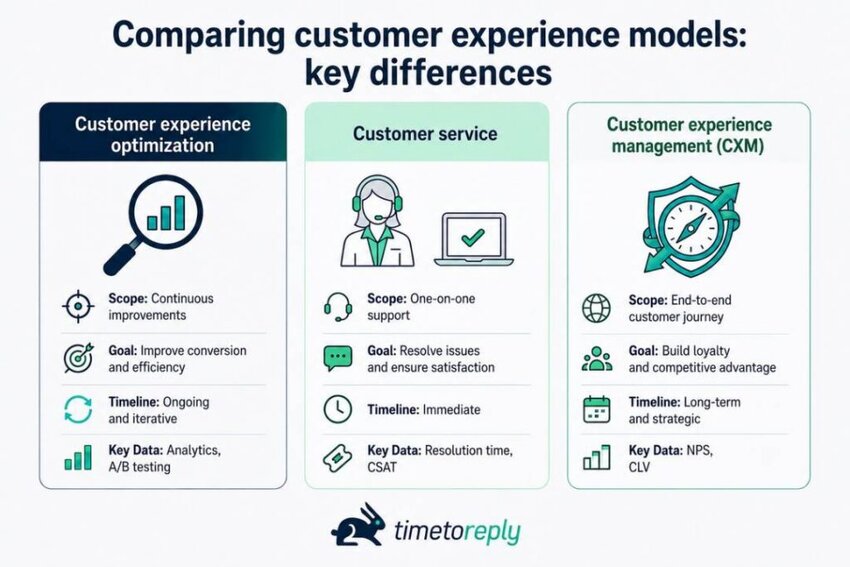
Image via timetoreply
Customer experience optimization improves the full customer journey through ongoing changes. It uses customer feedback to make the experience smoother and more enjoyable.
Customer experience optimization is important because it helps keep customers happy and loyal. A better experience makes people more likely to recommend your business to others.
Here is why customer experience optimization matters for your business.
Customer experience optimization helps businesses keep customers for longer. When each interaction is smooth, you’re likely to improve customer retention. They have fewer reasons to switch to another company when you solve problems on time.
Loyal customers also spend more money over time than new customers. They cost less to support because they already know your products and services. So improving customer satisfaction at each stage protects revenue you have already earned.
Another benefit of customer experience optimization is increased customer lifetime value. According to the Zendesk CX Trends report, the companies investing most in customer experience come out ahead.
They report 22% higher retention and 49% higher cross-sell revenue than their peers. Happy customers are more likely to buy again and try new products.
Record-retrieval firm Ontellus illustrates the benefits of customer experience optimization. The company used timetoreply to improve its email response times.
The share of emails answered within one business day increased from 62% to 86% as reported by Ontellus. Quick replies gave customers more confidence in the company and encouraged repeat business.
A better customer experience attracts new customers without increasing your marketing budget. Satisfied customers refer friends and colleagues, leave positive reviews, and defend your brand.
Referrals are a long-term benefit of customer experience optimization. They bring in new customers without extra marketing costs.
Improved customer experiences also add to your reputation over time. People trust businesses with positive reviews and personal recommendations. Positive experiences encourage customers to recommend your business and leave good reviews.
Competitors can lower prices or add new features, but trust takes time to earn. A great customer experience builds relationships that give your business an advantage.
Many customers do not stay because a business has the lowest price. They stay because the service is enjoyable. Businesses that improve customer experience give customers a reason to stay. Many customers return even when competitors offer lower prices.
Also Read:
CX optimization depends on key areas such as customer journey mapping and personalization. These components help businesses understand customer needs and improve customer service.
Here are the components of customer experience optimization that matter most.
Customer journey mapping visualizes every step a customer takes with your brand. It starts at awareness and continues through purchase, onboarding, and support. Customer experience optimization uses this map to improve every step of the journey.
A customer journey map also shows what customers think and feel at each stage. It highlights problems that make the journey difficult. It also shows the moments that create a positive experience.
Here is what a customer journey map involves.
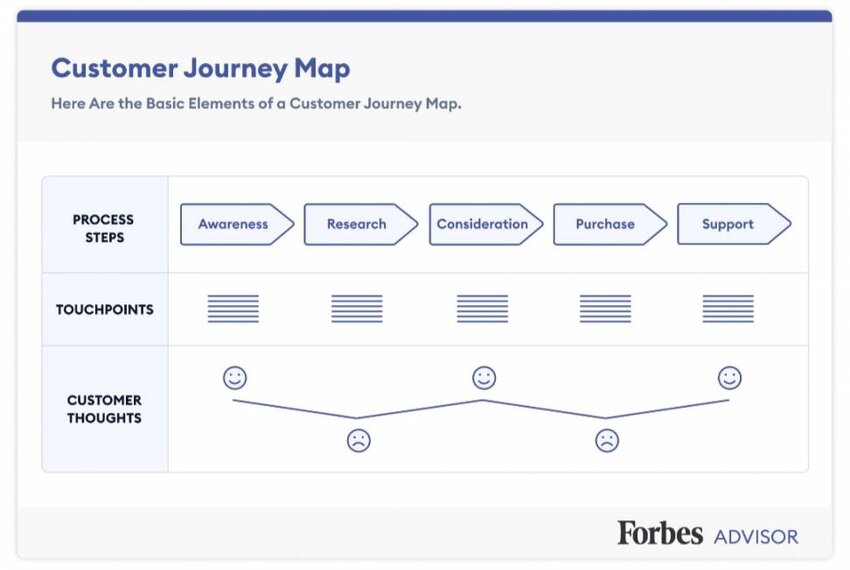
Image via Forbes Advisor
You need accurate data to make better decisions to optimize your customer experience. Useful data include quantitative metrics like conversion rates, support volume, and response times. You also need to collect customer feedback from surveys and interviews for context.
Different types of data from customer experience analytics answer different questions. Behavioral data shows the actions customers take or customer behavior. Customer feedback explains why customers take certain actions. Email response data also shows how quickly customers receive a reply.
Personalization in customer experience optimization means creating experiences based on customers’ needs.
Attentive 2025 Consumer Survey found that 90% of customers want more personalized experiences. As such, businesses that personalize their communication build stronger customer relationships.
Start simple, with segmentation based on history or customer preferences. Add more advanced triggers over time. Handle personal data responsibly and be transparent about it.
Customers should receive the same level of service by email, phone, or social media. Customer experience optimization relies on consistency across every interaction.
Keep customer information in one place. This way, every team can see the same customer data. Every team should follow the same service standards and response times policy.
Here is how a consistent omnichannel experience looks in practice.
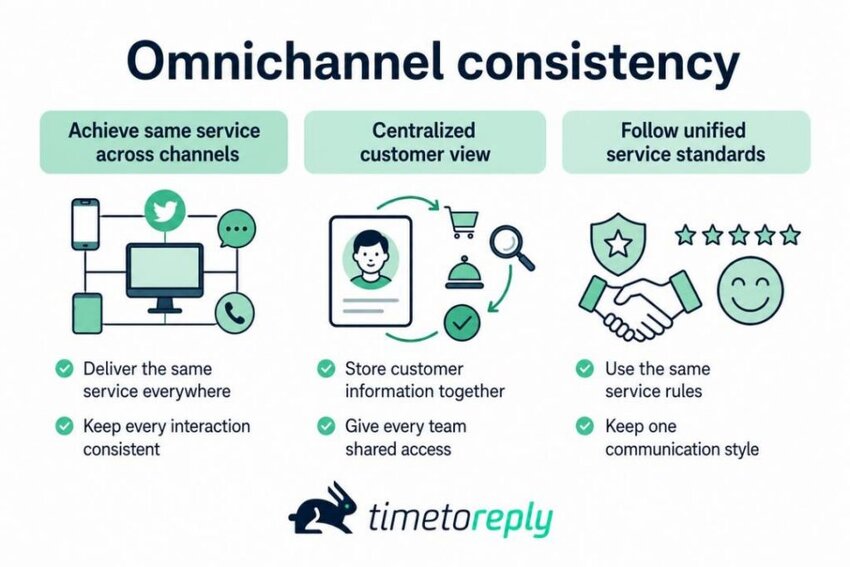
Image via timetoreply
Fast response times are an important part of customer experience optimization. Customers expect quick replies no matter which channel they use. A slow response can leave a poor impression, even when the final solution is good.
Unlike sentiment or brand perception, response time is easy to measure and act on. Set clear response time SLA targets for each team or account. Then track performance and fix delays as they appear. We will cover exactly how to measure this later in this guide.
Also Read:
You can implement customer experience optimization by following a clear process. Start by understanding your current customer experience. Then set clear goals, make improvements, and measure the results. Customer experience optimization works through regular journey improvements.
The five steps below provide a simple process that any business can follow.
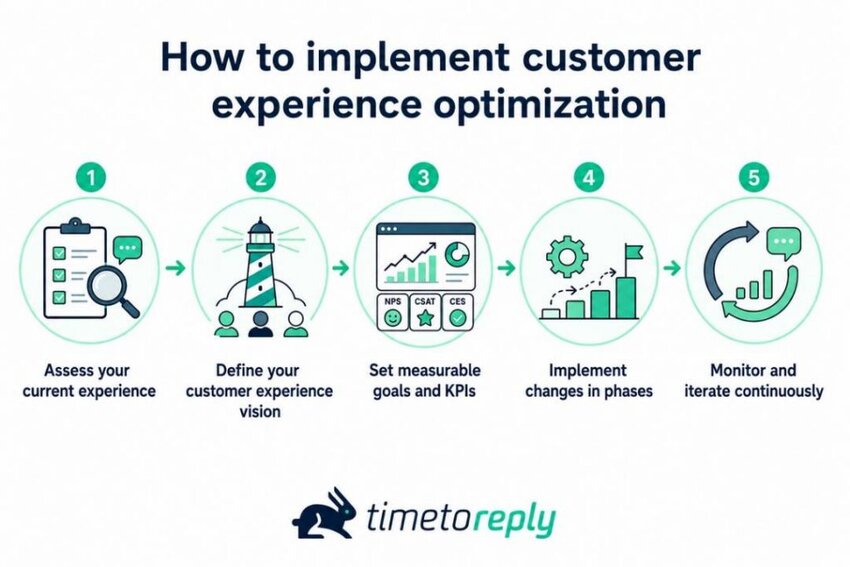
Image via timetoreply
Start with an honest audit of every touchpoint. Map each interaction from first contact to post-purchase support. Look at how each touchpoint works today. This gives you a clear picture of the current customer experience.
Use customer surveys to find gaps between your view and the customer’s experience. Benchmark against industry standards so you know where you stand.
Create a clear vision for the experience you want to deliver. It should reflect your brand values and business goals. That vision becomes your north star for every decision that follows.
Include teams from across the business in this process. Marketing, sales, product, and support all shape the customer experience. Set clear goals that everyone can understand.
Set baseline measurements and realistic key performance indicators (KPIs). Track both short-term and long-term results.
Common customer service metrics include Net Promoter, Customer Satisfaction, and Customer Effort Score. Response time is another useful metric for customer-facing teams.
These metrics show whether your customer experience optimization efforts are working. Review them often and use the results to guide future improvements.
Make improvements one step at a time. You can start with changes that are easy to implement and can deliver fast results. Use that momentum to fund larger projects.
Test new ideas with a small group before introducing them to everyone. Record every new process and train your employees. Following the same customer experience optimization process across every team improves consistency.
Review your performance often — monthly or quarterly. Look for new problems and new opportunities to meet customer expectations. Customer experience optimization should be an ongoing process, not a one-time project.
Use feedback to catch minor issues before they grow. Give one person or team clear responsibility for managing the process.
Customer experience optimization follows a five-step process. Assess your experience, define a vision, set KPIs, make changes, and track results.
The best customer experience optimization strategies improve response times and customer relationships. The strategies below are practical and effective for long-term customer experience optimization
Customers should complete tasks with as little effort as possible. If customers reach their goal in fewer clicks or emails, they leave happier. Low-effort experiences can promote loyalty.
Use self-service tools to improve customer experience. Knowledge bases, FAQs, and help centers answer common questions. That frees your team for the issues that need a human. Good customer service software makes this easier to manage.
Fast replies are one of the most effective customer experience optimization strategies. Long wait times often damage trust and reduce customer satisfaction. Response time is also easy to measure and improve.
Many businesses have improved customer experience by responding faster. Lead generation company, Lead Forensics, reduced its average email reply time from about four hours to less than two.
Telecoms agent Telarus also reduced response times in some teams from seven hours to two. HR platform Deel cut its reply times by half.
To get such results, you need visibility. Email response time tracking shows exactly how long customers wait, by team, account, or mailbox. Then you can set targets and hit them.
Here is an example of a response-time dashboard.
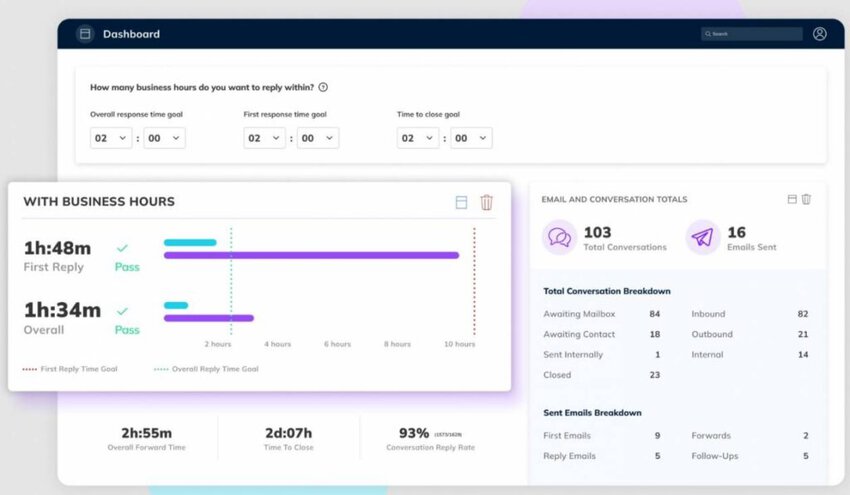
Image via timetoreply
Building strong customer relationships is another important part of customer experience optimization. Train employees to communicate with empathy and respect during every customer interaction.
Customer-facing teams should listen before offering a solution. They should acknowledge customer concerns and use respectful language. Honest and respectful communication builds trust over time.
Choose technology that solves customer problems without making the process more difficult. Customer experience optimization should combine automation with human support. Use chatbots for simple questions and routine requests. Give customers an easy way to speak with a person when they need extra help.
For email-heavy teams, use email analytics software to check customer service performance. Track response times, workloads, and gather customer feedback regularly.
Strong CX strategies focus on removing barriers and improving support efficiency. You can improve results by simplifying customer journeys using helpful technology.
Also Read:
Avoid focusing on only one part of the customer journey while ignoring the rest. Don’t make decisions without enough data or regular testing.
Customer experience optimization works best when businesses improve every touchpoint. Here’s a breakdown of common mistakes to avoid as you plan.
Teams polish their website and app while neglecting phone and email. Customers use email, phone, and live chat for support. A poor experience on one channel affects the whole customer journey. Customer experience optimization should cover every customer touchpoint.
Aim for consistent quality everywhere. Your weakest channel often sets the tone for overall customer satisfaction. So it deserves as much attention as your flashiest one.
Employees play a primary part in customer experience optimization. Poor training and unclear processes affect the quality of customer service. Frustrated teams without efficient customer support tools struggle to deliver positive customer experiences.
Invest in training, clear processes, and tools for simple processes. Measure employee satisfaction alongside customer service metrics.
Surveys are useful, but survey fatigue is real. Too many requests hurt response rates and data quality. They can also annoy the customers you are trying to please.
Use different sources to understand the customer experience. Review customer feedback, support requests, and customer behavior. Look for patterns across different data sources. Customer experience optimization requires acting on feedback, not only collecting it.
Testing changes before a full rollout reduces unnecessary risks. Businesses often make decisions based on assumptions instead of evidence. A change that looks good may create new customer problems. Small mistakes can become expensive after a full launch.
Test every major change with a small group first. Compare the results with your original process. Measure customer satisfaction and business performance together. Expand the change only after you see positive results.
Another mistake is not measuring performance anymore after making certain improvements. Customer experience optimization requires regular tracking and review. Customer needs and expectations change over time. A process that works today may not work next year.
Review your customer experience metrics on a regular schedule. Track response times, customer satisfaction, and customer retention. Look for new problems before they become larger issues. Use the results to guide continuous improvements.
Avoid ignoring key touchpoints, employee needs, customer feedback, testing, and performance tracking. A balanced approach supports smarter CX improvements.
Also Read:
Track experience and response-time metrics to measure your customer experience optimization results. Here is how they compare.
| Metric | What it measures | Scale or formula | Best used for |
| Net Promoter Score (NPS) | Loyalty and likelihood to recommend | −100 to +100 | Overall loyalty trends |
| Customer Satisfaction Score (CSAT) | Satisfaction with a specific interaction | Percentage of positive replies | Individual touchpoints |
| Customer Effort Score (CES) | How easy it was to get help | Low-to-high effort scale | Friction and ease of service |
| First response time (FRT) | Time before a customer gets a first reply | Average time to first response | Speed and responsiveness |
| Average response time (ART) | Typical time to reply across a thread | Average reply time | Ongoing service performance |
| SLA adherence | Share of replies within your target time | Percentage within SLA | Meeting service commitments |
NPS measures loyalty by asking how likely customers are to recommend you. Scores run from −100 to +100, and anything above zero is generally positive. Track the trend over time rather than a single reading.
Here is an example of how to calculate NPS. Subtract the percentage of Detractors from the percentage of Promoters.

Image via Giovanny Cifuentes
CSAT measures satisfaction with a specific interaction or your overall experience. Use it to check individual touchpoints and problem areas that broad metrics can hide. Keep surveys short and tied to the moment they measure.
Here’s what a CSAT survey scale looks like and how the score can be calculated.

Image via Arahoster
CES measures how easy it was for a customer to get what they needed. Low-effort experiences correlate strongly with loyalty. This metric often predicts churn before satisfaction scores do.
See how the CES question can be asked and how to calculate the score.

Image via DANAconnect
Response-time metrics connect customer experience with daily operations. They show how quickly customers receive replies. These metrics include first response time, average response time, and SLA performance.
Teams can use these numbers to set targets. Measuring reply speed helps teams improve workflows and balance workloads.
Track NPS, CSAT, and CES for perception. Add first response time, average response time, and SLA adherence for speed.
Also Read:
Customer experience keeps evolving, and a few trends are shaping what comes next. Artificial intelligence, hyper-personalization, and conversation analysis will influence customer service.
Here is where the field is heading and how to prepare.
Artificial intelligence is shaping customer experience through prediction and automation. Machine learning can flag at-risk customers before they churn. It can also suggest the next best action for your team.
Use AI responsibly for customer experience optimization. According to Salesforce’s 2024 report, only 42% of customers trust companies to use AI ethically.
So, to earn trust, use AI with transparency to support your team, not replace it. Tell customers when they are dealing with automation. Also, keep a human in the loop for sensitive moments.
Businesses will use more customer data to deliver highly personalized experiences. Customer experience optimization will use real-time data instead of broad customer groups.
Businesses can recommend products, services, and content based on current customer behavior. As personalization deepens, be clear about the data you use. Customers should have control over their personal information.
Teams want to understand customer conversations and response times. Every customer service email carries two kinds of signals. Operational ones cover reply time and workload. Relationship ones cover sentiment, intent, and urgency.
This is the idea behind timetoreply’s Smart Data. It’s an opt-in platform that uses AI-assisted insights to show sentiment and urgency. Those signals help leaders spot service risks early.

Image via timetoreply
Smart Data uses the same security-first foundation as the core analytics. It is certified to SOC 2 Type II and ISO 27001. As these signals mature, they help teams act on the tone of a conversation along with its timing.
The future is AI-assisted, hyper-personalized, and focused on the sentiment inside conversations. Trust, privacy, and responsible data use will remain important for long-term success.
Also Read:
1. Who is responsible for customer experience optimization?
Customer experience optimization is a shared responsibility across different teams. This includes marketing, sales, customer support, product, and operations. Leaders create goals, provide resources, and make sure teams work together.
2. How often should businesses review their customer experience strategy?
Businesses should review their customer experience strategy regularly. A monthly or quarterly review is okay for most companies. Review key metrics, customer feedback, and new challenges during each check.
3. What is the difference between customer experience and customer experience optimization?
Customer experience is how customers feel about their interactions with your business. It covers every touchpoint, including buying a product and getting support. Customer experience optimization focuses on improving those interactions. It uses feedback and data to find problems and make changes.
4. How do you improve customer experience?
First, review the current customer journey and identify common problems. Look at customer feedback and performance data to understand where improvements are needed. Next, set customer service goals and decide how success will be measured. Make small changes first instead of changing everything at once. Test new processes and track the results to see what works.
5. What are common customer experience optimization mistakes?
Avoid ignoring key touchpoints, employee needs, and customer feedback. Give every channel equal attention and use data from different sources. Test changes on a small scale before a full rollout.
6. What data is needed for customer experience optimization?
Customer experience optimization uses different types of customer data. Businesses collect feedback, survey responses, and customer behavior data. They also track metrics like response times and satisfaction scores. This data shows where customers face problems during their journey.
7. What is the difference between customer experience optimization and customer experience management?
Customer experience management sets the strategy for improving customer interactions. Optimization is the ongoing, hands-on work of improving specific touchpoints using data.
8. What is customer journey mapping?
Customer journey mapping shows the steps customers take when interacting with a business. It includes stages like discovering a brand, buying products, and getting support. Businesses use maps to understand customer needs at each stage.
9. How do you measure customer experience optimization success?
Use a mix of metrics. Use a mix of metrics. NPS measures loyalty, CSAT shows satisfaction, and CES measures effort. Track response times like first and average response time to measure service speed.
10. How long does it take to see results?
Results depend on the changes you make and how you measure success. Some improvements, like faster responses, can show results within weeks. Larger changes may take months to create noticeable results. Track performance regularly to measure progress.
11. What tools help with customer experience optimization?
Use customer feedback tools, analytics platforms, and support software. These tools collect insights from customer interactions and behavior. Feedback tools show what customers like or dislike about their experience. Analytics platforms track important metrics and performance changes. Support software helps teams manage requests and improve response times.
Also Read:
Customer experience optimization starts with putting customers first. It means making every step of their journey feel easy, quick, and consistent. The work pays off when you map the journey, act on data, and keep improving in small, tested steps.
Of everything you can improve, response time is one of the most measurable and immediate. Track it, set clear targets, and give your team the visibility to hit them. You will see the payoff in stronger loyalty, better reviews, and steadier revenue.
The timetoreply analytics tool helps customer-facing teams track and improve email response times. Teams can use it without changing their existing workflows. Book a demo and put your team’s response times to the test.
Get live inbox alerts and reply quickly to customer emails with timetoreply

Head of Customer Success @ timetoreply
Barry Blassoples is the Head of Customer Success at timetoreply, where he helps customer-facing teams boost revenue and protect brand reputation by providing actionable insights to improve their business email response times. He has over 15 years of leadership experience across customer success, sales, and marketing roles in high-growth tech companies.



Trusted by high-performing inbound sales teams and customer-facing teams globally.
Close more deals and delight more customers with the faster, smarter, deeper email analytics and performance optimization software that works straight from your team’s inbox.