
A customer service SLA is a documented agreement that defines how quickly and effectively your support team must respond to and resolve customer issues. It sets measurable service parameters such as response times, resolution targets, escalation rules, and support availability. This helps businesses deliver consistent service, improve team performance, and keep customers satisfied.
A customer service SLA defines the standards your support team must meet when handling customer requests. It outlines measurable service parameters such as first-response times, issue-resolution goals, and escalation timelines.
As such, it lets customers know exactly what level of service to expect.
You can use customer service SLAs to improve accountability and manage customer expectations. This way, you can deliver more consistent support across the services you offer. Clear service agreements also help you prioritize urgent tickets, track team performance, and maintain high customer satisfaction levels.
Without a defined customer service SLA, response times become inconsistent, and dissatisfied customers are more likely to leave for competitors.
In this guide, we explore what customer service SLAs are, the different types available, and the key components to include. We also look into real examples and how to create effective service agreements for your own support team.
A service level agreement is a formal document that defines the expected level of service between a provider and a customer, vendor, or internal team. It establishes measurable performance standards, responsibilities, timelines, and accountability rules for a particular service.
SLAs are commonly used in customer support, IT, SaaS, and managed services to clarify expectations and reduce disputes. They may cover service parameters such as uptime guarantees, response times, issue resolution targets, escalation procedures, and reporting requirements.
All service agreements share one purpose: they eliminate ambiguity by making expectations explicit and enforceable for both parties.
A customer service SLA is a support-specific agreement that sets clear expectations for how customer inquiries, complaints, and requests will be handled.
Unlike a general SLA, it focuses specifically on support and customer experience. This includes how quickly the first responding agent replies and how quickly issues are resolved. It also addresses what happens when those targets are missed.
Service level agreements range from customer-based SLAs to service-based SLAs and multilevel SLAs. Here’s how each of these meets specific service expectations:
The right SLA type depends on your customer mix, service complexity, and the standards your business can consistently uphold.
The key components of a customer service SLA include the standards, responsibilities, and performance expectations your support team must meet. To build a strong customer service SLA, focus on these essential components:
Strong customer service SLAs turn expectations into measurable commitments that drive satisfaction, accountability, and lasting customer trust.
Also Read:
A customer service SLA matters because it turns vague service promises into measurable commitments. It protects your team, builds customer trust, and gives everyone a clear standard to work toward.
In 2026, delivering top-tier service is essential for customer loyalty and growth. In fact, 82% of consumers say a business is only as good as its service.
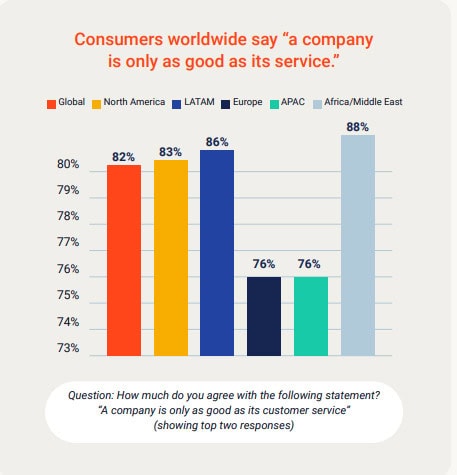
Image via GENESYS
Here’s why a customer service SLA matters.
A customer service SLA gives your team concrete, agreed-upon targets rather than arbitrary internal goals.
When your SLA states that urgent tickets receive a response within one hour, there’s no ambiguity. Agents know exactly what’s expected, and customers know what they’ll receive.
Real service agreements drive accountability far more effectively than made-up metrics.
Without a customer service SLA, agents often prioritize whatever lands at the top of the inbox rather than what actually matters most. That often leads to delays on urgent tickets and inefficient workflows.
SLAs fix this by defining which tickets require immediate attention and which can wait.
Your team ends every day confident they’ve honored their customer commitments and focused their energy in the right places.
Service agreements protect both customers and support teams by documenting expected response and resolution times.
If a customer complains about a delayed reply, agents can refer to the agreed-upon SLA targets and escalation procedures. These provide a clear, professional way to address frustration without accepting unwarranted blame.
Defined SLAs reduce misunderstandings and create more transparent customer interactions.
Also Read:
A customer service SLA ensures every client receives a consistent support experience regardless of which agent they reach.
That consistency builds confidence and loyalty, ensuring satisfied customers rate your business high enough to renew, refer, and return.
Internally, your team gains a shared playbook. It gets clear processes, defined tools, and measurable standards that scale reliably as you grow.
Customers extend trust to businesses that demonstrate accountability. A customer service SLA outlines your service commitments, defines remedies such as service credits for breaches, and demonstrates to customers that your team stands behind its promises.
According to a Salsify report, this kind of trust has a direct commercial impact. 69% of customers trust a brand because of its reputation, while 61% do so because of customer service and experience.

Image via Salsify
Clear SLA metrics help support teams work more efficiently. Customer service agents prioritize the right tasks, specific thresholds trigger automated responses, and managers can track progress against real benchmarks.
A customer service SLA that specifies a four-hour resolution time for technical issues, for example, keeps the entire support workflow aligned. It reduces delays and eliminates guesswork.
Businesses can also use SLA reporting tools to identify bottlenecks, balance workloads, and improve team performance over time.
Compliance obligations are expensive, with some firms spending up to 19% of their annual revenue on meeting regulatory requirements.
A customer service SLA helps reduce that burden by embedding compliance expectations directly into service targets. For instance, a 10-minute response guarantee for patient data requests keeps healthcare teams aligned with data privacy laws.
SLAs also generate auditable records of service delivery, providing documented proof of compliance when it’s needed most.
Also Read:
The right customer service SLA depends on your support goals, customer expectations, and the particular service you provide. Here are some practical service agreements businesses commonly use to improve response times, team performance, and customer satisfaction.
A response time SLA sets expectations for how quickly support agents should reply to incoming tickets. Customers who receive timely replies feel heard and are far less likely to escalate or churn.
When they know they’ll receive a reply within a defined wait time, customers feel more confident that their issue is being handled.
Tools like timetoreply can help teams monitor and enforce these targets. Once you connect it with your support team’s email inboxes, you can set targets for your support agents to aspire to. For example, you can set first-response time goals to measure how quickly your agents respond to new tickets. You can also track the average ticket resolution time to see how long support tickets remain open.

Image via timetoreply
You’ll see clear data on your team’s reply times, helping you understand whether you’re on track to meet your SLAs. If there are peak times where your support team struggles to hit your expected reply times, your data highlights the issue. You can then leverage this data to address staffing shortages or improve your processes to get you back on track.
A resolution time SLA defines how quickly your team should resolve customer issues. It balances customer expectations with operational realities, ensuring your team delivers timely, effective solutions.
While some requests require investigation or escalation, clear resolution targets help support teams prioritize work. Setting a customer service SLA that defines the expected resolution time for issues is, therefore, a crucial part of managing customer expectations.
For example, say a customer reaches out with a problem, but they know you resolve most issues within six hours. They’ll have a certain confidence that lets them relax and let your team handle the situation, rather than pushing for an instant resolution.
This clarity enhances customer satisfaction by aligning service performance with customer needs. It also helps support agents balance workloads without sacrificing response quality during busy support periods.
Consider segmenting resolution targets by issue complexity. Simple requests can be handled within two hours, while technical ones are sorted within 24 hours. This makes your customer service SLA more realistic and actionable for agents.
An uptime SLA defines the level of service availability customers can expect during agreed business hours. It reassures customers that downtime will be minimal and performance will meet agreed‑upon service parameters.
This type of customer service SLA is especially important for software providers and IT teams that must minimize downtime disruptions. Indeed, if you’re paying for software and it experiences downtime, you’ll feel like it’s money wasted. Your customers will feel the same way when promised availability isn’t met.
Setting clear uptime and availability expectations helps customers understand whether your team is delivering the promised service levels.
If you’re creating a customer service SLA for a service business, you might set weekly hours dedicated to each client account. This helps manage service delivery and ensures commitments are transparent.
It also sets expectations early, so customers don’t expect responses outside your team’s scheduled support hours.
Also Read:
A support availability SLA explains when customers can access live support and expected response coverage. This customer service SLA helps businesses communicate clear availability standards, especially when support teams operate within limited time zones.
Defining support hours upfront sets honest expectations and prevents frustration when agents aren’t available around the clock. For example, if you know you can’t offer priority support between 12 AM and 5 AM, let customers know upfront. See how Atlassian breaks down its Priority Support resources to customers.

Image via Atlassian
If not, there’s always a chance they’ll reach out during those hours, looking for help, and be left waiting. Being transparent about availability builds trust and helps define key performance indicators for response times and coverage.
Your customers won’t mind if you set limits on your support availability, as long as you’re clear about it upfront with them.
An escalation customer service SLA defines how quickly unresolved issues move to higher support levels after first contact resolution fails.
Clear escalation timelines help teams manage urgent requests more quickly and reduce delays in critical support issues. When customers have critical problems, they want to know their ticket will quickly reach the right support agents.
A customer service SLA makes this happen by defining key performance indicators such as escalation speed. You can use your service desk software to set targets, such as routing high-priority tickets to a manager within 30 minutes.
For telecom service providers, a customer service SLA might require that network outage tickets be escalated within 20 minutes. If your support team struggles during busy business hours, you can tweak staffing or processes to hit your service levels.
Clear escalation paths also reduce confusion between support tiers and help teams resolve complex technical issues faster. Documenting which agent tier handles each issue type prevents mistakes during high‑pressure moments and keeps your internal customer service SLA running smoothly.
Also Read:
A customer satisfaction score SLA sets measurable targets for post-support experience ratings. Setting a CSAT target in your SLA gives your team a measurable benchmark for service quality across every interaction.
This type of customer service SLA sets a clear target for how happy people should feel after engaging with your service desk. You can track performance metrics by gathering service survey ratings. With tools like customer feedback platforms and online surveys, you can achieve up to 90% positive feedback.
For example, an SLA for an online retailer might aim for a 4.5/5 rating on support chats. This pushes support agents to deliver a stellar customer experience and maintain consistently positive experiences.
Clear data on satisfaction scores helps you spot where your support team shines or needs a boost to meet service expectations.
A service credit SLA outlines compensation customers may receive if agreed service levels are missed. Offering credits for delayed response times or unscheduled outages builds trust and reinforces accountability during service disruptions. It also shows commitment to maintaining high standards.
You can set these guarantees in your service desk system to automatically track breaches and issue credits. For example, you might offer a 10% bill credit if service availability dips below 99%. SAP compensates production tenants whenever unscheduled service outages cause availability to fall below the standard 99.7% uptime SLA.

Image via SAP
This transparency helps you avoid unhappy customers and maintain admirable business results. It also encourages support teams to monitor service performance closely and resolve recurring operational issues before they affect larger customer groups.
Also Read:
Having a customer service SLA in place is a strong start, but getting real value from it requires ongoing attention. Here are practical tips to help you strengthen your internal SLA processes and maintain satisfied customers, while improving team performance:
Also Read:
A well-designed customer service SLA streamlines service performance, aligns your team around what matters, and gives customers confidence in your support. Building one effectively starts with understanding your customers’ needs and the essential skills customer-facing teams bring to every interaction.
Here are some straightforward steps to follow:
Also Read:
1. What is a customer service SLA and why is it important in 2026?
A customer service SLA is a contract between a service provider and a customer that outlines the expected services. This can include service performance metrics like response time and service availability.
2. How do customer service SLAs improve customer satisfaction?
A customer service SLA can enhance customer satisfaction by clearly outlining service expectations. This includes specifying key metrics such as the resolution time for support tickets or the average response time.
When support agents prioritize service delivery based on metrics, they can resolve issues quickly and keep customers satisfied. A customer-based SLA, for instance, might promise priority support during regular business hours, reducing wait time.
3. What are common examples of customer service SLAs?
Common customer service SLAs include:
4. Can a customer service SLA protect a service provider from unhappy customers?
It definitely can! It sets clear service expectations and performance metrics, reducing disputes with unhappy customers. It keeps all parties on the same page when it comes to appropriate behavior and responsibilities.
5. How do support teams use SLA metrics to measure performance?
Support teams live for SLA metrics. They can use tools like timetoreply to track key performance indicators, such as average time to reply or defect rates.
They then use this data to regularly review and optimize support operations. Additionally, teams continually monitor performance metrics to identify gaps in support, thereby improving support levels and enhancing customer satisfaction.
Also Read:
Creating a customer service SLA is only the first step. To improve support operations, you must actively track response times, monitor team performance, and adjust service parameters as customer expectations evolve.
That’s where timetoreply helps. The platform connects with your shared inboxes and provides real-time analytics on reply times, workload distribution, and SLA performance. And that’s across teams and individual agents.
You can set measurable targets, quickly identify missed SLAs, and improve accountability with customizable dashboards and reports. This makes managing SLAs easier while helping support teams deliver faster, more consistent service.
The timetoreply platform works with O365, Outlook, Gmail, MS Exchange, and IMAP. Schedule a demo today to see how your team can improve response times and keep more customers satisfied.
Get live inbox alerts and reply quickly to customer emails with timetoreply

Head of Customer Success @ timetoreply
Barry Blassoples is the Head of Customer Success at timetoreply, where he helps customer-facing teams boost revenue and protect brand reputation by providing actionable insights to improve their business email response times. He has over 15 years of leadership experience across customer success, sales, and marketing roles in high-growth tech companies.



Trusted by high-performing inbound sales teams and customer-facing teams globally.
Close more deals and delight more customers with the faster, smarter, deeper email analytics and performance optimization software that works straight from your team’s inbox.