
Lead response time is the time between a prospect contacting your business and a customer service rep responding. You can improve it by training your team, setting a target response time, and leveraging technology to optimize your processes.
Speed and efficiency are key factors in determining the success of a business. This is particularly true when it comes to lead generation and sales. According to an Optifai Pipeline Study, responding to a lead within five minutes increases close rate by 32%. The odds drop every minute you wait.
If you’re looking to capitalize on this, this post covers what lead response time is and why it’s important to your business. You’ll learn the ideal response time and the best practices for improvement.
Lead response time refers to the time it takes for a business to respond to a lead after they have expressed interest in its products or services. This interest might be filling out a contact form, sending an email, or interacting with a chatbot.
Leads rarely contact a single company when comparing products or services. So, your team’s ability to respond quickly gives you an edge over other businesses. Therefore, lead response time is a critical metric that can significantly impact a company’s bottom line.
Optifai’s study found that delaying response by 30 minutes drops your close rate from 32% to 24%.
Customers expect quick replies from businesses. Those who fail to meet expectations risk losing out to competitors who do.
By prioritizing lead response time, you can improve your chances of winning over new customers. You can also achieve high customer satisfaction and loyalty in the long term.
Also Read:
Knowing where you fall on the lead response time scale is the first step toward improvement. The table below outlines the 2026 benchmarks, per the previously cited Optifai study.
| Performance level | Response time | Close rate |
| Best-in-class | < 5 minutes | 32% |
| Good | 5-30 minutes | 24% |
| Fair | 30-60 minutes | 18% |
| Slow | 1-24 hours | 15% |
| Very slow | 24+ hours | 12% |
Lead response time is crucial to business success because responding within five minutes increases the likelihood of closing. Fast responses increase conversion rates, build trust, secure competitive advantage, and save time.
It’s hard not to overstate the importance of lead response times, no matter the industry or business size. Here are a few reasons why lead response time can significantly impact your bottom line.
As mentioned before, businesses that respond to leads within 5 minutes achieve 32% close rate. This is 2.6 times higher than waiting for 24 hours or more.
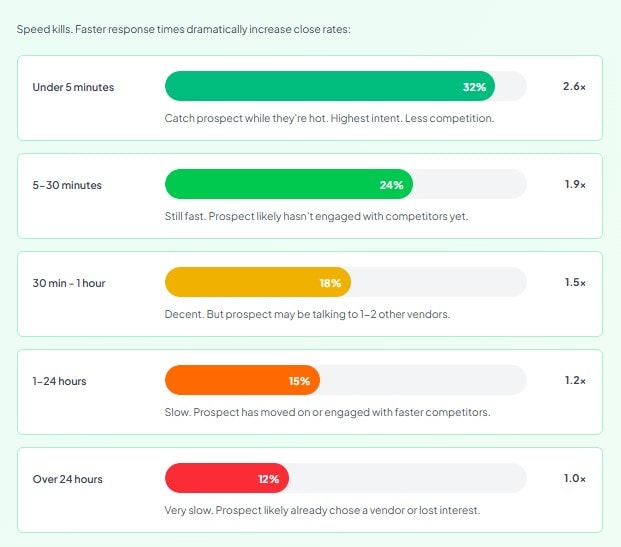
Image via Optifai
When you prioritize fast lead response times and share the right message, it can significantly increase your conversion rates. It can also boost your sales and make your business more productive.
A fast lead response time increases the likelihood of closing a sale and leaves a positive impression on potential customers. It also builds trust and loyalty with your customers. Providing quick customer service resolution for inquiries shows you value their time.
Nowadays, customers have a multitude of options when it comes to products and services. Providing a quick customer response time than your competitors helps you stand out and win the deal.
Quick responses save time and streamline your workflow. You can spot the most promising leads and focus your efforts on those most likely to convert.
A fast lead response time is crucial to your business success because it directly influences conversion rates. It gives you an edge over competitors, increases customer satisfaction, and improves workflow efficiency.
Also Read:
The ideal lead response time is five minutes or less. Responding within this time frame increases your close rate by 32%. Your chances of closing drop to 24% if you wait up to 30 minutes.
You can calculate lead response time by measuring the difference between when a lead submits an inquiry and when a sales rep makes the first contact.
The average lead response time across industries is 47 hours. However, response times can vary significantly based on the industry, with some businesses responding within minutes and others taking days.
So, for example, if you work in B2B SaaS, the average response time is 38 hours, while in manufacturing it’s 62 hours. Keep in mind these are averages, but they can help you to set your goals.
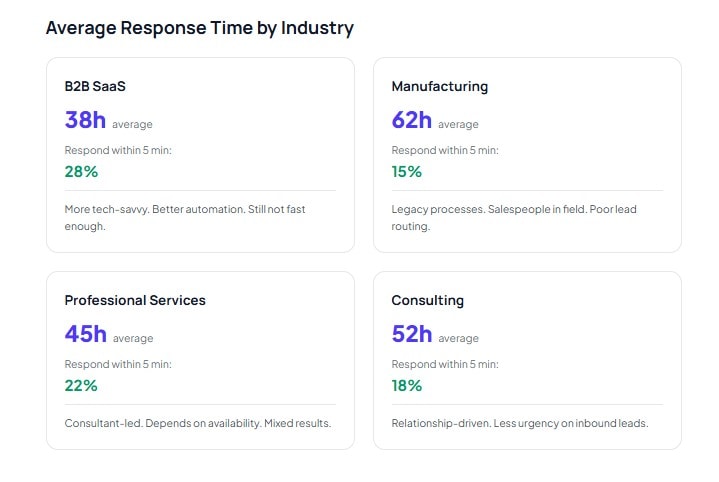
Image via Optifai
The ideal lead response time is within five minutes. According to 2026 benchmarks, hitting this window results in a 32% close rate.
Once you cross the one-hour mark, your close rate drops to 18%. The longer you wait to respond, the more likely the lead will lose interest or find a competitor who responds faster.
While five minutes is the best-in-class standard, Optifai’s study shows an execution gap:
Keep in mind that consumer behavior is constantly evolving. This means the five-minute window is likely to reduce over time as expectations grow.
Calculate lead response time by subtracting the time of lead inquiry from the time of first response. Here’s the formula:
Response time = Time of first response – Time of lead inquiry
So, if a lead submits a form at 9:00 AM and you reply at 9:15 AM, your response time is 15 minutes.
To get the average lead response time, add up the total response time in a given period. Divide it by the number of leads your team contacted, as shown below.
Average lead response time = Sum of lead response times/Total number of leads
You can manually measure lead response time or use an email response time tracking software. It helps you see your team’s performance and ways to improve it. It also increases your chances of converting leads into customers, thereby building a solid and successful business.
Also Read:
Improving lead response time requires real-time monitoring and automation. It ensures your team responds within the five-minute benchmark.
Slow lead response times can result in missed opportunities, decreased lead conversion rates, and ultimately, lost revenue. Here are some best practices to follow.
First and foremost, you obviously want to monitor your lead response times. The right software can be enormously beneficial here.
For example, timetoreply’s Ignite allows you to easily monitor and track your team’s response times to new leads and customer enquiries. It provides you with real-time data on how long it takes for your sales representatives to respond to new leads.
You can track individual response times and the average response times for your team. You can also leverage the data to improve email response time. It allows you to identify bottlenecks in your sales process and implement improvements to reduce lead response times.
Determine a target response time for all incoming leads and share it with your sales team. Ideally, this should be within minutes of receiving the lead.
With timetoreply, you can easily configure your target response time for different types of leads. You can also assign them to the appropriate sales representatives or teams.
By doing so, you can ensure that your sales process is efficient. When leads are handled promptly, it increases the chances of conversion.
This email response time tracking software also allows businesses to monitor their sales representatives’ performance in meeting the set target response time.
Managers or supervisors get real-time notifications when a response time is exceeded. It allows them to take immediate action, ensuring that the lead is not lost to a competitor.
There are plenty of best practices for lead follow-ups, including offering a personalized experience. Cadence is also important.
With timetoreply’s AI-powered platform, companies can master customer service analytics. They can track their sales team’s response times and suggest better follow-up cadences to improve lead conversion rates.
They can also use it to automate replies to frequently asked questions. This ensures no potential customers are left waiting for a response.
Utilize a CRM system to track all lead interactions and follow-up activities. This can help you prioritize and manage your leads effectively and avoid missed opportunities.
timetoreply integrates with popular CRM systems, such as Salesforce and HubSpot. This way, you can streamline your lead response management and improve your overall sales process.
You can easily track your team’s response times directly from your CRM. It provides a holistic view of your sales pipeline.
Provide regular training to your sales team on effective lead response management and how to prioritize and manage leads effectively. This can include strategies for handling different types of leads and techniques for improving lead conversion rates.
Leverage technology such as chatbots and AI-powered lead response tools to automate lead qualification and follow-up activities. This can help you respond to leads faster and more efficiently. It frees up your sales team to focus on high-priority activities.
Again, software like timetoreply will help you monitor and improve your lead response times, amongst other things.
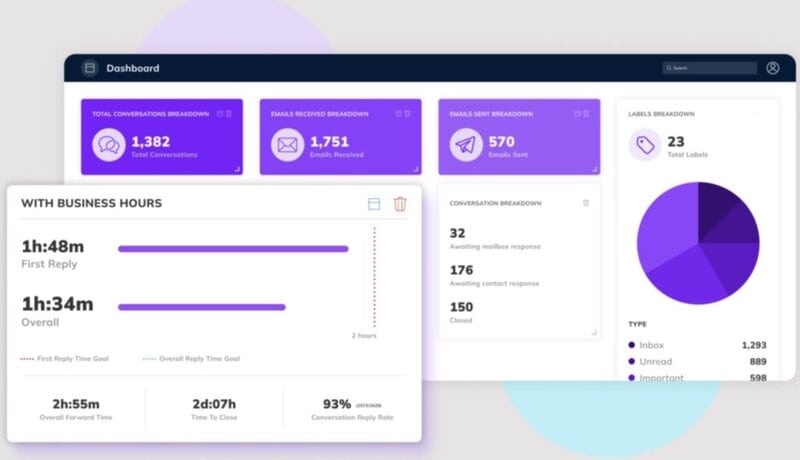
Image via timetoreply
This, in turn, allows you to identify areas for improvement and take action to optimize your lead response process.
Setting response time targets and real-time alerts prevents missed opportunities. Prioritize CRM tools and AI-powered automation to ensure your team stays competitive.
Also Read:
1. What does lead response time mean?
Lead response time is the duration between when a potential customer (a lead) expresses interest in your product or service and when your team responds to that inquiry with initial contact.
2. What is the ideal lead response time for inbound leads?
The consensus in the sales and marketing industry is that the ideal lead response time for inbound leads is within five minutes of their initial inquiry.
Contacting leads within this timeframe can increase the chances of connecting with them and qualifying them as potential customers since the lead is still actively engaged.
3. How can I measure my current lead response time?
You can measure your current lead response time by tracking the time between when a lead submits an inquiry and when your team responds. Use CRM tools or analytics platforms to review timestamps and analyze patterns.
4. What happens if I delay the initial contact with a lead?
First, the prospect’s interest level is likely to decrease rapidly over time. The longer it takes to follow up, the colder the lead becomes.
They may forget the specifics of their inquiry, lose enthusiasm, or even find solutions from competitors who offer fast response times. This can reduce your chances of making a meaningful connection and progressing the lead.
5. How do I get my sales team on the same page for faster responses?
This would involve clear communication and consistent reinforcement. First, establish clear guidelines around acceptable actual response times and implement tools that can alert reps the moment a lead comes in.
You can also implement training sessions and performance incentives to reinforce the value of speed to lead. When everyone understands the impact of fast response times on conversion rates, they’re more likely to act with urgency.
We know this post covers a lot of information. To help, we’ve listed the key takeaways below:
Ready to improve your lead response time and boost your sales conversion rates? Request a demo to see how our solution can help you streamline your lead response management and increase your sales efficiency.
Don’t let slow lead response times cost you valuable opportunities. Try timetoreply today and start turning leads into customers!
Get live inbox alerts and reply quickly to customer emails with timetoreply

Head of Customer Success @ timetoreply
Barry Blassoples is the Head of Customer Success at timetoreply, where he helps customer-facing teams boost revenue and protect brand reputation by providing actionable insights to improve their business email response times. He has over 15 years of leadership experience across customer success, sales, and marketing roles in high-growth tech companies.



Trusted by high-performing inbound sales teams and customer-facing teams globally.
Close more deals and delight more customers with the faster, smarter, deeper email analytics and performance optimization software that works straight from your team’s inbox.