Making your business more productive involves improving communication, automating repetitive tasks, delegating responsibilities, and optimizing workflows. When teams do this, they respond faster, stay focused, and get more work done.

Knowing how to make your business more productive isn’t just about doing more; it’s about allowing employees to focus on more productive tasks instead of unnecessary work.

With competition getting tough, customers expect faster responses and better experiences. Increasing business productivity helps your team to meet those expectations while keeping operations efficient.

In this post, we’ll discuss practical steps on how to make your business more productive.

Read on to find out some helpful tips.

Why does productivity matter for customer-facing teams?

Productivity matters for customer-facing teams because it determines the quality of service and customer satisfaction. Knowing how to make your business more productive allows teams to respond to inquiries faster, resolve issues more effectively, and provide a seamless customer experience.

High productivity also allows team members to manage larger workloads without sacrificing the personal touch that keeps customers loyal. By optimizing productivity, businesses ensure that their customer-facing teams have the capacity and focus to meet customer needs.

Now you know why productivity matters, let’s discuss how to make your business more productive.

Also Read:

How can you make your business more productive?

You can make your business more productive by focusing on high-value activities and building a healthy workplace for your team. It saves time and creates efficient workflows that support sustainable business growth.

Knowing how to make your business more productive takes careful strategizing. Here are some key steps you can take to ensure every area of your business operates efficiently.

1. Set clear goals and priorities

Setting clear goals and priorities gives your team direction. It helps them focus on work that’s related to business goals. It reduces confusion and prevents team members from wasting time on activities that don’t add value to the business.

If you’re learning how to make your business more productive, start by ensuring everyone is on the same page and understands what truly matters.

Here are some tips on how to make your business productive through setting clear business goals and priorities:

  • Set specific and measurable goals: Vague goals like “We want to grow” give your team nothing to plan around. Instead, define targets with specific numbers and a timeline. For example, “We want to increase our monthly revenue by 20% in six months.” Specific goals make it easier to allocate resources and track progress.
  • Focus on high-impact work: Juggling too many tasks can reduce team productivity. It dilutes team members’ focus and slows everything down. Instead, let the whole team work on one task that contributes the most to your business growth. Ensure that everyone handles their piece of the project simultaneously.
  • Set realistic deadlines: Deadlines create a sense of urgency, but overly tight deadlines can be harmful. Give your team enough time to finish their tasks without compromising quality. This helps team members manage stress, leading to better outcomes. It also helps avoid a pile of subpar work in the long run.

2. Streamline communication channels

Streamlining communication channels helps make your business more productive by reducing confusion. It reduces back-and-forth communication, so team members can find information faster rather than switching between emails, chats, and meetings.

According to Grammarly’s 2025 Productivity Shift report, over 80% of workers agreed that poor communication increased stress and lowered productivity. Others noted that it reduced work quality and job satisfaction.
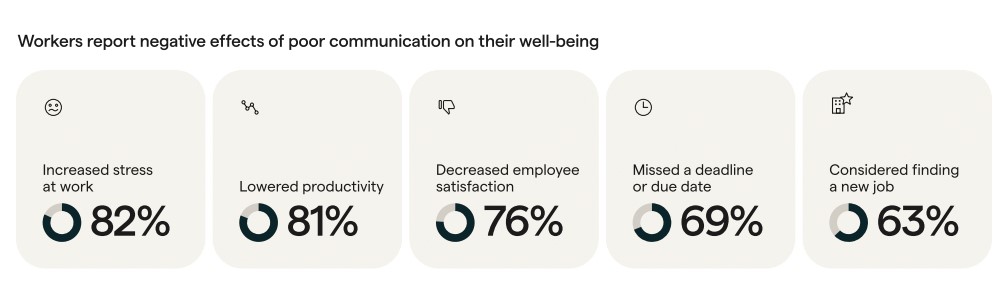
Productivity report

Image via Grammarly

When communication flows better, work moves faster. Effective communication ensures that every team member knows what to do, who’s responsible for what, and what’s already been done. This kind of clarity saves time, prevents mistakes, and reduces the back-and-forth that slows everything down.

Here’s how to make your business more productive through streamlining communication:

  • Set clear rules for each channel: Not every conversation needs an email or a meeting. Use chat for urgent questions, email for detailed updates, and project tools for task progress. This alone reduces miscommunication and saves valuable time across the team.
  • Reduce unnecessary notifications: Constant pings interrupt focused work periods. Encourage employees to mute channels that aren’t directly relevant to their role. With reduced interruptions, employees can do deep work, leading to better output and minimal errors.
  • Use fewer communication apps: Too many productivity apps can duplicate conversations and create confusion. Choose the right tools and keep communication in one place whenever possible. This way, you won’t lose messages or miss following up on important discussions.

Also Read:

3. Leverage automation

Automation can make your business more productive by freeing your team from time-consuming, low-value work. It gives them more capacity to do tasks that move your business forward.

Automation doesn’t mean replacing people. It means giving people better tools so they can do more without getting burned out.

If you want to know how to make your business more productive through automation, try the following:

  • Automate appointment scheduling: Avoid the back-and-forth of finding meeting times via email. Use tools like Calendly or Google Calendar to let customers automatically choose available time slots.
  • Use chatbots for customer support: Chatbots can handle customer queries, such as FAQ, order status, and pricing. This ensures fast response times while freeing support teams to handle complex tasks that require human attention.
  • Leverage automated email responses: Set up auto-replies for common inquiries so customers get quick acknowledgment. It manages expectations, reduces follow-up emails, and ensures no messages are ignored during busy periods.

Introducing the timetoreply extension

Managing email communication manually can become a huge waste of time, especially for customer-facing teams. When employees spend too much time sorting messages or deciding what to answer first, it can slow response times and affect productivity.

When handling large volumes of emails, productivity tools like the timetoreply Extension can help automate workflow. Teams can use it to:

  • Track the right performance metric: Teams can customize the email analytics metric they want to track, from response time to SLA compliance. It reduces delays and helps employees see their progress in real time.
  • Prioritize emails automatically: It displays emails that need attention first, so your team won’t waste time on a cluttered inbox. This way, team members can handle high-priority emails fast, which can lead to better customer retention.
  • Improve team collaboration: Managers can assign emails to the right team member to enhance first contact resolution. This keeps workflows moving and reduces missed deadlines.
  • Get real-time alerts for response risks: Custom alerts notify teams when response targets are at risk of being missed. This helps teams respond faster, maintain SLA standards, and improve customer satisfaction.

Using better tools helps organize shared mailboxes. It also reduces routine work, saves time, and contributes to business growth.

4. Delegate effectively

Effective delegation means assigning the right task to the right people. It allows you and your team to spend more time and energy where it counts most.

Instead of trying to handle everything yourself, assign responsibilities to people with the right skill set for the task. When you delegate effectively, you build efficient workflows where everyone operates in their area of strength.

If you’re wondering how to make your business more productive, here are examples of tasks and responsibilities you can delegate:

  • Administrative tasks: Assign tasks such as handling emails, scheduling meetings, and organizing files to a virtual or administrative assistant. It reduces time spent on repetitive tasks and creates room for more productive work.
  • Marketing: Team members can handle social media, content writing, graphic design, or email campaigns based on their strengths. If the skill isn’t available in-house, hire a freelancer to get the work done faster.
  • Project management: Let someone oversee deadlines, track progress, and manage communication among team members. You can also use a project management tool to assign tasks and monitor progress.

Overall, delegating tasks should start small. Pick an area that takes up a lot of your time but doesn’t need your personal touch. That’s how to make your business more productive without overwhelming your staff.

Also Read:

5. Reduce distractions

Reducing distraction involves allowing employees to stay focused and complete tasks without constant interruptions. Fewer distractions improve time management and business productivity.

Microsoft’s 2025 Work Trend Index found that employees are interrupted every two minutes on average during the workday. As a result, work feels chaotic and draining. Employees would need extra time to regain full focus, which affects productivity.

Here’s how to make your business more productive by reducing distractions:

  • Focus on one task at a time: Multitasking may feel productive, but it can divide attention and reduce the quality of work. Encourage employees to complete one task before moving on to the next.
  • Reduce interruptions from people: Quick questions from co-workers or household noise, if you work remotely, can break your flow. Set clear working hours, put a “do not disturb” sign, and limit interactions to urgent issues.
  • Limit unnecessary meetings: Too many meetings can divert your staff’s attention from more productive tasks. Schedule meetings when needed, invite only essential participants, and request updates when a meeting isn’t truly needed.

6. Foster a healthy work environment

A healthy work environment helps make your business more productive by reducing stress. When employees feel supported, they’re more engaged, communicate better, and spend more time on productive work.

Indeed’s Work Wellbeing report found that 87% of workers want employers who care about how they feel at work. This shows how strongly workplace culture can influence engagement and performance.

So, how do you make your business a healthy place for your staff to increase productivity?

  • Set attainable goals: Unrealistic targets create anxiety, reduce morale, and make employees dread coming to work. So, set goals with room for adjustment to keep your team motivated and produce better work.
  • Encourage open communication: Build a culture where employees can ask questions, share ideas, and raise concerns. People focus better when they feel safe when they can talk without fear of being ignored or shot down.
  • Respect work-life balance: Encourage breaks, reasonable hours, and resist the urge to reach out after employees clock off. A team that gets proper rest shows up more focused and effective.
  • Address challenging attitudes promptly: Unresolved conflicts Sometimes, employee behavior can create tension within the team. It’s important to handle these situations immediately and thoughtfully using the right channels of communication.
  • Invest in tools that simplify work: Outdated systems, slow software, or unclear processes can hinder productivity. Equip your team with the right tools to do their job efficiently, without the frustration of dealing with constant tech issues. Less time wasted on broken systems means more time spent on actual work.

Also Read:

7. Invest in training and development

Another way on how to make your business more productive is to invest in training and developing your employees. Increasing your employees’ knowledge base helps them perform better in their roles. Also, providing them with growth opportunities fosters loyalty and reduces attrition.

Some of the things you can do to improve productivity through employee training and development include the following:

  • Ask your team what they struggle with: Before making any financial investment, ask your employees what challenges hinder their productivity. Pinpointing their weaknesses and strengths helps you better understand how you can help them. This way, you’ll be able to identify the skills and tools they need to be more productive.
  • Offer sensible training: Employee training doesn’t always mean sending everyone to a big conference or hiring an overpriced coach. It could be as simple as paying for online courses or creating internal ‘how-to sessions,’ where experienced employees teach newcomers and share advanced strategies.
  • Incorporate training into their workday: Don’t set training schedules during their off time because that could negatively impact work-life balance and reduce morale. Incorporate it into their daily work hours. One hour a week would suffice.
  • Repeat: Training isn’t a one-time thing. Trends and technology change, and so do customer expectations. So, don’t treat employee training like an event, but rather a regular business investment that ensures productivity doesn’t drop dangerously.

8. Improve your customer feedback loop

A robust customer feedback loop enables customers to easily share their thoughts about your business. It also makes it easier for you to take meaningful action based on their input.

How to make your business more productive involves establishing a continuous flow of two-way communication with customers. This enables them to share valuable insights that lead to meaningful improvements in your products, services, or processes.

Improving customer feedback loops can boost productivity because it helps your team focus on the right priorities. Here’s how to make your business more productive by improving customer feedback loops:

  • Make your business easy to reach: Avoid hiding your contact form or making customers click through multiple pages to leave a review. Display feedback options where your customers are already spending their time on product pages, at checkout, or in confirmation emails.
  • Ask better questions: Stop with the generic “Tell us what you think.” That’s vague. Instead, ask specific, actionable questions that provide valuable insights. Consider questions like “What almost stopped you from buying today?”
  • Act, then close the loop: Don’t leave customer conversations hanging. If someone tells you something useful, follow up. Even a short “Thanks for the heads-up—we’ve fixed it” customer service email makes people feel heard.
  • Track results: After implementing changes based on feedback, track what happens. Are returns decreasing? Is customer support receiving fewer calls about recurring issues? Are reviews becoming more positive?

9. Monitor and measure performance

The final tip on how to make your business more productive is monitoring and measuring performance. Monitoring isn’t about micromanaging your business staff, but identifying bottlenecks and finding areas where processes can be streamlined for greater efficiency.

Here are some aspects you should measure and monitor when learning how to make your business more productive:

  • Employee output: Tracking this helps you identify who needs support, who’s overwhelmed, and where key processes may be lagging. Consider the following:
    • Tasks completed per day/week: Are tasks being completed on time? Are they meeting the required output?
    • Quality of work: Productivity isn’t just about speed but quality. Does the output frequently require rework or revisions?
    • Time spent per task: If a task that requires 30 minutes to complete is taking 3 hours, that’s a red flag.
  • Time management: Managing time appropriately can boost productivity. To achieve this, focus on the following key areas:
    • Start and stop times: Are work hours being used effectively?
    • Idle time: How much time is being lost to distractions or unclear priorities?
    • Meeting time: Are meetings too long or too frequent?
  • Customer feedback and satisfaction: Happy customers stick around and spread the word. If they’re not happy, you’ll know where your business may be falling short. Maintain customer satisfaction by tracking the following:
    • Support tickets and response times: Are your customers waiting a long time to hear back from your support team?
    • User reviews or ratings: Are people happy with your product or service? If not, what changes would they like to see?
    • Customer retention: Are your customers coming back, or are you losing them after a single purchase?

Also Read:

FAQ

1. What increases the productivity of a business?

Productivity increases when your employees know what they’re doing, why they’re doing it, and how to do it better with the right tools.

This entails setting clear goals, establishing solid systems, and streamlining processes for simplicity. If your team constantly stops to ask for direction or fix broken processes, that’s time and energy wasted, negatively affecting productivity rates.

2. How do small businesses become more efficient?

Small businesses have to maximize their resources, especially if they’re limited. Ensure that systems are running smoothly to prevent roadblocks hindering productivity.

Automate, prioritize, or delegate tasks to minimize repetitive tasks. This enables you to focus on high-impact work that delivers real value to your customers.

3. What are the 5 key success factors for a business?

Most successful businesses have a few things in common, including:

  • A clear purpose
  • A product or service that addresses consumer needs
  • Reliable and consistent revenue
  • Supportive leadership
  • A stable business plan

4. What is the number one reason businesses fail?

Cash flow challenges are one of the most common reasons businesses fail. Even if customers love your product, it’s challenging to keep the lights on when expenses outweigh income and cash flow slows down.

Sometimes, it’s pricing, slow payments, or simply spending more than you’re bringing in.

5. What are the 7 stages of business growth?

The 7 stages of business growth include:

  1. Seed – The idea stage when the concept is born
  2. Startup – Testing the idea and trying to gain initial traction
  3. Growth – Sales increase, operations expand, and things can often get hectic
  4. Established – The business becomes more stable and organized
  5. Expansion – Entering new markets or launching new products
  6. Maturity – Operations are steady, and growth levels off
  7. Renewal or Decline – Innovate to stay relevant or face a slowdown

Also Read:

Final thoughts

This guide has shown you how to make your business more productive. However, increasing business productivity is a multifaceted challenge. But it’s entirely achievable with the right tools and strategies. Customer-facing teams can benefit immensely from implementing productivity tools, effective time management strategies, and fostering a collaborative, supportive work environment.

Incorporating timetoreply into your workflow can significantly boost productivity by ensuring faster, more efficient communication, ultimately driving better outcomes for your business.

By integrating these productivity-enhancing strategies, your customer-facing teams will be better equipped to handle their tasks efficiently, improving customer satisfaction and overall business success. Don’t wait—start optimizing your productivity today!


Barry Blassoples

Head of Customer Success @ timetoreply
Barry Blassoples is the Head of Customer Success at timetoreply, where he helps customer-facing teams boost revenue and protect brand reputation by providing actionable insights to improve their business email response times. He has over 15 years of leadership experience across customer success, sales, and marketing roles in high-growth tech companies.



Latest Blogs

The latest advice on reply time & lead response optimization, and email performance improvements

How to add a shared mailbox in Outlook and track metrics

How to add a shared mailbox in Outlook and track metrics

A shared mailbox gives teams one place to manage support, sales, or customer emails. This guide explains how to set up a shared mailbox in Outlook,...

Read more
Front vs Zendesk vs Freshdesk Which one is better

Front vs Zendesk vs Freshdesk: Which should you choose?

The choice between Front vs Zendesk vs Freshdesk as an email management tool depends on your business needs. Front is best for teams that need...

Read more
Best customer service software solutions

17 best customer service software solutions for 2026

The best customer service software helps you improve communication efficiency and keep your team organized as your business grows. There are...

Read more


Time to see the insight, improvements and results for yourself?

Trusted by high-performing inbound sales teams and customer-facing teams globally.
Close more deals and delight more customers with the faster, smarter, deeper email analytics and performance optimization software that works straight from your team’s inbox.