
Customer relationships can end without warning. Long gaps in usage, declining engagement, fewer logins, and unanswered emails signal that a customer may be leaving soon.
The challenge for businesses isn’t that they don’t have information; it’s that they often fail to interpret it at scale. This is why churn prediction has become crucial for long-term growth.
In this guide, we’ll dive into the definition of churn prediction, its importance, and different methods for predicting churn.
Churn prediction is identifying which customers will stop using a product or service within a given time period. You can spot signs of churn using historical customer data, behavioral patterns, and machine learning techniques.
It could be how often they log in, if they’ve stopped calling support, or if they’ve ignored recent customer service emails.
In simple terms, churn prediction answers a crucial question: Which customers are most likely to leave, and why?
Customer churn doesn’t happen overnight. It develops through small, repeated moments, such as delayed email responses and unresolved issues. That’s why you should know the signs early.
Here are three reasons why you should start predicting churn.
Customer service teams are usually the first to notice churn signals, long before a customer cancels their subscription. As such, churn prediction allows a subscription business to act on those signals in real time and retain customers before they cancel.
Instead of waiting for churn to appear in monthly or quarterly reports, teams can intervene during live conversations. An agent can ask, “I noticed you haven’t had a chance to use [Feature X] lately. Is there something we could change to make that more useful for you?”
Before the call ends, the agent can trigger a one-question survey, such as a Net Promoter Score. It provides immediate, measurable data that’s useful for improving customer satisfaction levels.

Image via FeedCheck
Also Read:
Missed service level agreements (SLAs) are one of the strongest contributors to customer churn. When response times are slow or issues remain unresolved beyond agreed thresholds, customers begin to lose confidence in your brand.
Churn prediction matters because it shows how service failures directly affect customer retention. It also reveals which SLA breaches are most likely to lead to churn and which ones won’t have as much impact over the long term.
For teams working in shared inboxes, this insight helps them prioritize. Instead of responding in chronological order, agents can focus first on conversations where delayed responses might lead to churn.
When patterns emerge across data, such as customers getting confused during onboarding, you’ll have a better idea of why they leave. This insight allows you to improve customer experience using both targeted and measurable ways.
Instead of making broad changes, you can refine onboarding flows or train customer service agents to improve interactions that consistently lead to dissatisfaction. When customers receive timely support and smoother interactions, they feel acknowledged and supported.
This sense of reliability keeps customers engaged and builds long-term loyalty, making churn less likely even when issues arise.
Also Read:
There are several types of models for churn prediction. Here are some of the most reliable ones.
This model predicts customer churn by splitting data into branches based on behavior and attributes. It provides visual insights into how different customer actions lead to either churn or retention. Here’s an example:
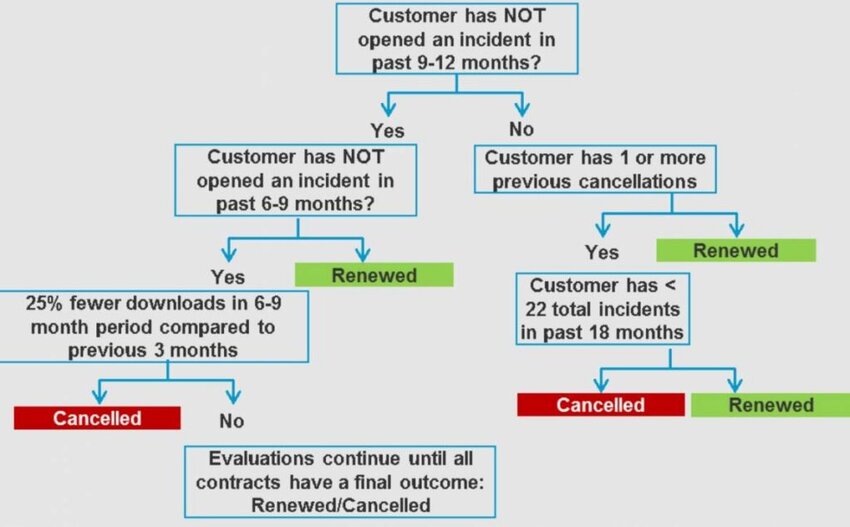
Image via Mosaic Data Science
It weighs various customer actions, such as late payments, to calculate a single probability of whether they’ll leave. Because it shows which behaviors carry the most weight, managers can see what’s driving customers away and fix those issues.
This churn prediction model combines results from multiple models. This reduces errors and produces more stable results.
Also Read:
1. What is churn prediction?
Churn prediction involves analyzing business data to identify customers who are likely to unsubscribe from your service. Businesses use this data to improve customer retention strategies.
2. What are the main causes of churn?
The main causes of churn include:
3. What is churn probability?
Churn probability is the estimated likelihood that a customer will churn within a specific period. It’s expressed as a percentage or score generated by a prediction model, helping teams prioritize customers who may be losing interest in your business.
4. What is a churn prediction model?
A churn prediction model uses historical data to identify potential churn. It identifies behavioral patterns that indicate which customers are most likely to leave.
5. What does churn mean in business?
Churn refers to the loss of customers over a period. It’s commonly used as a metric to measure retention, especially in a subscription business, where ongoing customer relationships directly impact revenue.
6. What does a 20% churn rate mean?
A 20% churn rate means that 20 out of every 100 customers stop doing business with a company during a specific period.
7. Which model is best for churn prediction?
There is no single best model for churn prediction. The right model for your business depends on how much data you have, what you want to achieve, and how easy the results are to understand.
8. Is higher or lower churn better?
Lower churn is always better because it shows that customers are satisfied. It reduces the cost and effort required to replace lost customers.
Churn prediction helps businesses identify at-risk customers before they lead to loss. For customer-facing teams, it connects everyday support performance to long-term retention. Response times, SLA compliance, and conversation quality become signals that guide retention strategies.
Tools like timetoreply play a key role in this process by offering visibility into shared inbox performance and SLA adherence. When combined with prediction techniques, this level of insight helps businesses improve response workflows and retain existing customers.
If your team relies on shared inboxes, book a demo with timetoreply and turn support performance into a measurable retention advantage.
Get live inbox alerts and reply quickly to customer emails with timetoreply

Head of Customer Success @ timetoreply
Barry Blassoples is the Head of Customer Success at timetoreply, where he helps customer-facing teams boost revenue and protect brand reputation by providing actionable insights to improve their business email response times. He has over 15 years of leadership experience across customer success, sales, and marketing roles in high-growth tech companies.



Trusted by high-performing inbound sales teams and customer-facing teams globally.
Close more deals and delight more customers with the faster, smarter, deeper email analytics and performance optimization software that works straight from your team’s inbox.