
The average email response time across industries is around 12 hours, but customers expect replies much faster. Delayed responses frustrate customers, reduce trust, and can cost your business sales and retention opportunities.
According to Zendesk’s 2026 report, 88% of customers expect faster responses than they did a year ago. Yet only 37% of companies are currently meeting response time expectations.
Among businesses that do, the average email response time is 12 hours and 10 minutes. That’s a long wait for any customer, far longer than they might be willing to endure.
In this article, we’ll cover average email response time benchmarks by industry, practical steps to reduce yours, and why faster replies directly affect your customer retention and conversion rates.
The average email response time is 12 hours.
We arrived at that figure by looking at average response times across industries, including finance, real estate, logistics, retail, and corporate travel, and finding the average between them.
Companies around the world are leaving their customers, sales leads, and even team members waiting for almost two days before replying to them.
What’s even more surprising is how the average email response time is disconnected from customer expectations. A Salesforce study found that 77% of customers expect an immediate reply when they contact a brand, as illustrated by the image below:
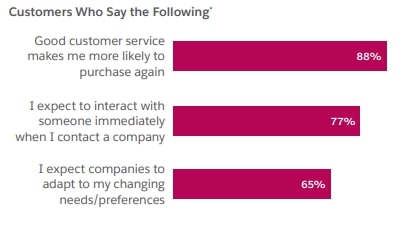
Image via Salesforce
The data shows how quick customer service resolution equals better customer experiences.
Also Read:
Average email response times vary widely by industry, ranging from 12 hours in logistics to 17 hours in retail.
To stay ahead of your competitors, you first need to understand the average email response time in your industry. We’ve compiled data on average email response times across corporate travel, finance, logistics, real estate, and retail industries.
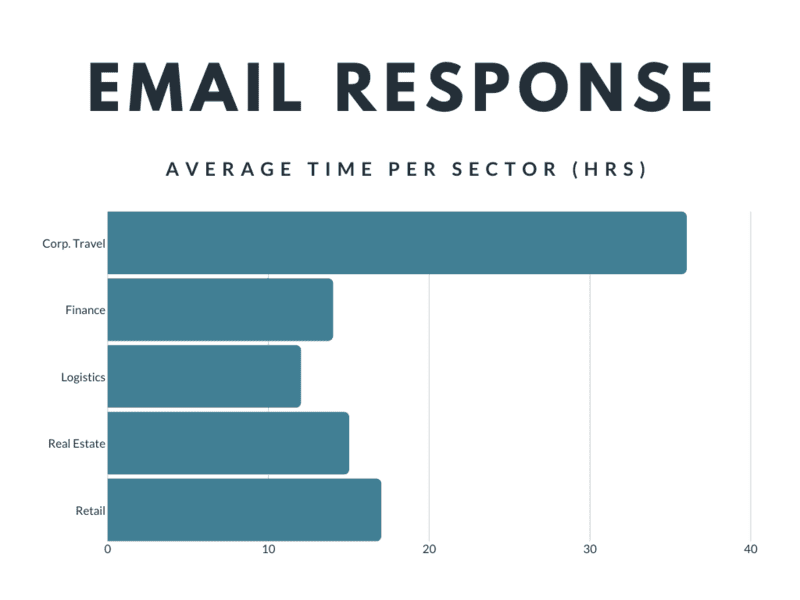
According to EmailAnalytics’ 2026 report, the average email response time in the travel sector is just under 15 hours. Given how time-sensitive corporate travel inquiries are, that’s a window many customers won’t wait out.
This points to possible revenue leakage. Corporate travel contracts tend to be large and recurring. Customer inquiries are time-sensitive, and a fast average email response time plays a big role in winning business.
Customers who aren’t serviced promptly will switch providers. You can use various customer support tools to reduce your average response time, because speed really matters in this industry.
The finance sector performs better, though not by much. Its average email response time is 14 hours. That’s still a long wait that gives leads plenty of time to find other options in a highly saturated market.
The finance industry is populated with ads, affiliates, and promoted content, so getting a lead is tough enough. Why risk losing them by taking too long to respond?
Being the first responding vendor to reply gives you a measurable competitive advantage in a sector where leads are comparing multiple options at once.
Optimizing your average email response time with timetoreply means your advertising spend doesn’t go to waste. Every lead who reaches out receives a timely response, keeping them in your pipeline longer.
The logistics industry is the best performer on this list, with an average email response time of 12 hours. That might sound reasonable, and relatively speaking, it is.
But nearly half of all customers expect a reply within 4 hours. That makes the logistics average response time three times slower than what customers actually want. There’s clear potential for maximizing email impact in logistics by closing this gap.
Logistics teams that reduce their average email response time to under 4 hours will have a real edge over competitors still at the industry average. Exceeding customer expectations on response speed is one of the fastest ways to build loyalty in this sector.
Also Read:
With an average email response time of 15 hours, the real estate sector isn’t doing too badly at first glance. But a closer look at the data tells a different story.
According to the cited Salesforce study, 61% of organizations said they proactively addressed customer inquiries. However, only 33% of customers agreed with that claim:

Image via Salesforce
This gap shows how quickly trust erodes when expectations aren’t met. Real estate customer service teams still have a lot of room to improve their average email response times.
The retail industry is massive, expected to grow to $8.6 trillion in the United States alone. You’d expect an industry this size to have fast average email response times. Unfortunately, that’s not the case.
The average email response time for retail businesses is 17 hours. That’s the slowest of any industry when you factor in how high customer expectations are in this space.
There are outliers, of course. Disney’s retail department, Abercrombie, and Office Depot have all brought their average email response times down to under 2 hours. That shows what’s possible when speed is treated as a priority.
It also shows how lead response times affect sales. Imagine contacting two retail businesses; one replies within 2 hours, while the other takes 17 hours. That’s not a competition — customers will always go where they feel valued.
Here’s how average email response times break down across industries:
Also Read:
The most effective way to reduce your average email response time is to combine the right tools with clear team goals and processes.
How quickly and professionally you respond to emails can directly impact your brand reputation and operational efficiency. It can also help you improve your email response rate and customer satisfaction.
Here are some best practices to reduce your average email response time.
Your team is busy. Their daily tasks mean they can’t check their inbox around the clock. But if a key sales lead replies to your outreach or a customer reaches out with a concern, you can’t leave them waiting.
One of the most effective ways to improve your email response times is to use a real-time alert system.
The easiest way to set this up is by using timetoreply. After your alerts go live, the system acknowledges receipt of every priority email and instantly notifies the right person, so nothing gets missed.
Once you’ve configured your alerts, your team gets notified whenever a priority email comes in. They can jump straight into their inbox and start replying. Customer emails get faster responses, and your sales leads see that your team is on the ball.

Image via timetoreply
Your team already has a long list of KPIs to hit. If you’re not setting reply-time goals, it’ll be hard for them to prioritize average email response time as a metric to improve.
Start with clear, realistic targets. For example:
Once these goals are in place, your team has something concrete to work toward. You can enhance productivity with email management software and improve the average email response time across individual team members and shared inboxes alike.
Keep in mind that context matters. If a big project deadline is coming up, average response times may slip temporarily. That’s not always a bad thing if the project delivers strong value for your customers. The goal is consistency over time, not perfection on any single day.
Every month, or over a time period that makes sense for your business, audit your average email response time metrics. Go through them in a team meeting and assess how they compare to your goals, team averages, and industry benchmarks.
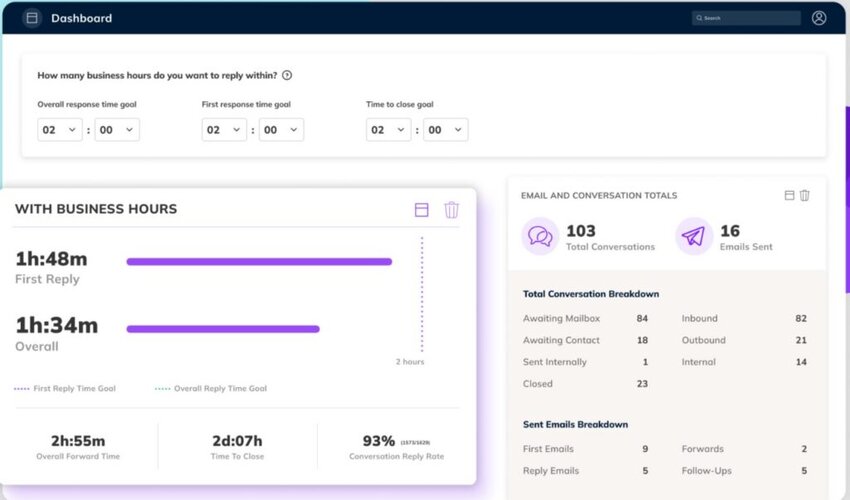
Image via timetoreply
For example, you might notice that sales leads are being left too long. Or that customer emails about a specific issue are taking longer than usual to resolve.
In these cases, you can improve email communication skills and work with your team to find out why the average email response time is slow.
Unlike manual tracking, using an email analytics platform gives you a live view of how individual team members are performing against your targets. This makes it easier to accurately measure email response time and fix bottlenecks quickly.
Most situations with longer average email response times come down to process issues rather than individuals ignoring emails. For example, your customer service team needs easy access to up-to-date documentation to solve problems quickly. If that’s not in place, average response times will suffer.
A practical way to reduce your average email response time is to use email templates and standard operating procedures (SOPs). These help your sales and customer service teams improve the customer experience without starting from scratch with every reply.
This approach helps you:
A strong knowledge base of email templates also means your team doesn’t have to reinvent answers to common questions. When incoming emails follow a familiar pattern, a ready-made template lets your team respond quickly without sacrificing quality.
The system acknowledges receipt of the inquiry instantly while your team prepares a more detailed follow-up, which keeps customers happier during the wait.
Work with your team to build these. Find out which questions come in most often, which ones take the longest to answer, and which ones have standard responses. Build your email templates around those, not the other way around.
If five emails land in your inbox at the same time, at least one of them is more urgent than the others. Treat your business emails accordingly.
Use a triage system to move high-priority emails to the top of the queue. This gives your team clarity on what needs a reply first and what can wait. Here are some examples to illustrate the difference.
High-priority emails include:
Lower-priority examples of follow-up emails include:
The right triage system will depend on your team’s setup and goals. But having one in place helps your customer service and sales teams make better decisions about which emails get answered first.
It also gives you cleaner productivity metrics to review during your monthly audits, since low-priority threads won’t inflate your average email response time figures.
Finally, you need a standard email response time policy. This is a set of guidelines that defines expectations for email usage across your company and teams.
You can use it to set different standards for different departments. Customer support may need to reply faster than your marketing team. Sales may need a shorter average email response time than your operations team.
A well-structured email response time policy should also account for work hours, excluding weekends where necessary. This way, your targets are realistic for your team’s schedule.
You can also use it to create service level agreements for key accounts, ensuring your highest-value clients receive faster responses than the general average.
You can also add client-specific service level agreements for key accounts directly into your policy. timetoreply then lets you track your team’s performance against those SLAs in real time.
This gives managers a clear benchmark and gives every other team member clarity on what’s expected of them.
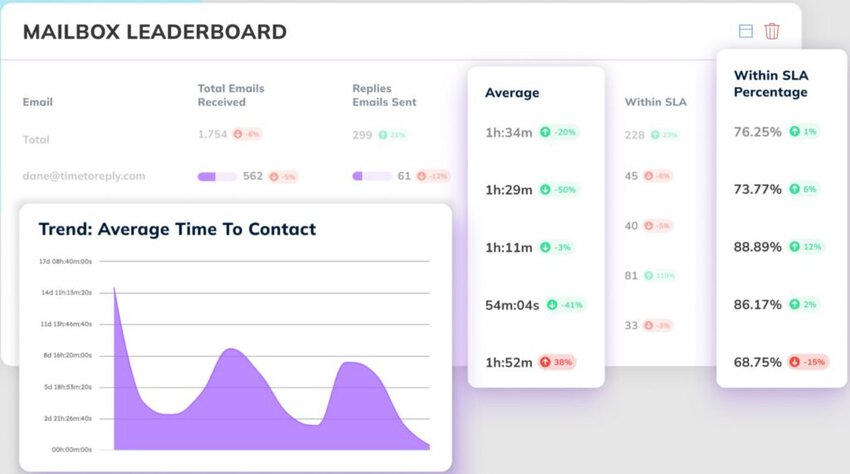
Image via timetoreply
Over time, you can adjust the email response time policy as your goals evolve. Make sure it’s a living document your team refers to regularly, not something they read once and forget.
Reducing your average email response time comes down to visibility, structure, and accountability. Track where delays are happening, set clear goals and policies, and build templates and triage systems. Together, these make fast responses the default across your team.
Also Read:
Your average email response time shapes customer experience. A slow response costs you trust, retention, and revenue. A fast one builds loyalty, closes more deals, and keeps your team running at its best.
Here are the key reasons your average email response time matters.
No one likes waiting for a reply after sending a straightforward question or concern. If you leave a customer waiting too long, they’ll start wondering if their email was delivered or if you’re ignoring them entirely.
That’s why improving your average email response time is one of the most direct ways of achieving higher customer satisfaction levels. Customers who get fast replies feel valued, and that feeling keeps them coming back. This essentially helps reduce customer churn.
One timetoreply customer, Swift Momentum, saw its average email response time improve by 300 to 400% after it started measuring and incentivizing faster reply times.
Its customers now get a consistently better experience and always know their questions will be resolved quickly.
When a sales lead reaches out, it’s because they’re actively looking for a solution. Chances are, they’re also talking to your competitors at the same time.
According to a RevenueHero study of 1,000 B2B companies, 63% never responded to inbound leads. Also, those that did took an average response time of 29 hours to reply.

Image via RevenueHero
Your team’s ability to respond within the first hour is one of the biggest competitive advantages you can have.
An immediate response signals to the lead that your team is attentive and ready to help — long before your competitors have even seen the email. If your team responds quickly to incoming emails, you’ll stay ahead of the pack in the sales process.
The average professional responds to emails during business hours, which means being first to contact a lead — especially outside peak hours — gives you an edge that’s hard to close.
Once you start measuring your average email response time, you can consistently find ways to reduce it. The result is more conversations with qualified leads and more sales.
Improving your average email response time isn’t just about outward-facing emails. It also helps your team work better internally.
For example, if a team member needs key information before a sales call or help replying to a customer service email, a slow internal response leaves them stuck. Building a culture where team members reply to each other promptly means everyone can do their best work. That shows up in your results.
Every email your team sends or doesn’t send shapes how your brand is perceived. A fast average email response time tells customers you take their time seriously and that their concerns matter to you.
Over time, this consistency builds trust. And trust is what keeps customers from looking elsewhere when something goes wrong.
Your average email response time affects every part of your business. It shapes customer satisfaction, sales conversion, team efficiency, and brand perception. The companies that treat response speed as a priority consistently outperform those that don’t.
Also Read:
1. How long should it take to respond to an email?
Ideally, you should respond to emails within 12 hours to show that you’re committed to addressing customer inquiries and concerns promptly. For customer-facing teams, the target is under four hours during business hours. For inbound sales leads, aim for under 30 minutes. The faster your team responds, the better your chances of retaining customers and converting inquiries into sales.
2. What is a good average email response time?
A good average email response time is under 12 hours. However, replying within 4 hours is ideal for customer emails or business-related emails. For sales teams handling inbound leads, the benchmark is under one hour. Anything beyond 24 hours puts you at risk of losing customers or leads to a competitor who responded faster and made a better first impression.
3. What is the 24-hour rule for email?
The 24-hour rule suggests replying to emails within a day, excluding weekends, to show reliability and professionalism. It signals to customers, leads, and colleagues that their message has been received and is being acted on. For customer-facing teams, 24 hours should be the absolute maximum.
4. How do I politely follow up on an email?
To follow up politely, wait one to two business days before reaching out again. Keep your message short and direct — reference your original email, restate what you need, and provide a clear next step for the recipient. Avoid language that sounds impatient or accusatory.
5. What are the 4 Cs of email etiquette?
The 4 Cs include Clear, Concise, Courteous, and Correct. A clear email states its purpose upfront. A concise email gets to the point without unnecessary detail. A courteous email maintains a respectful tone throughout. A correct email is free of spelling and grammatical errors. Together, these four principles help your team communicate professionally and reduce back-and-forth that slows down your average email response time.
6. How do you calculate average email response time?
Add up the total reply times for all emails in a given period, then divide by the number of emails replied to. Email analytics tools like timetoreply automate this, giving you a breakdown by individual team members, mailbox, and time period — no manual tracking needed.
7. What is a reasonable email response time for customer service?
For customer support teams, under four hours during business hours is a reasonable target. Top-performing teams aim for under one hour. Anything beyond 24 hours risks pushing customers toward a competitor.
8. How does email response time affect customer satisfaction?
Slow responses are one of the most common causes of customer frustration. Fast average email response times and consistent replies signal reliability, build trust, and directly improve customer satisfaction scores over time. Customers happier with your response speed are also more likely to stay loyal.
9. How does a slow average email response time affect your brand reputation?
When customers or leads wait too long for a reply, it shapes how they perceive your business. Consistently slow responses signal that your company doesn’t prioritize communication, which can damage trust and make it harder to retain customers or win new business.
10. How can I reduce my team’s average email response time?
Start by measuring your current average email response times to identify gaps. Then set clear reply time goals, build email templates for common questions, and use a triage system to prioritize urgent incoming emails. A solid knowledge base also helps your team respond quickly without sacrificing quality.
Also Read:
Your average email response time is one of the most telling indicators of how well your business serves its customers and handles its sales pipeline.
The industry average response time sits at 12 hours across corporate travel, finance, logistics, real estate, and retail. That’s far longer than most customers are willing to wait. Closing that gap gives you a real competitive advantage.
If you need a platform to help you measure email response time and manage your company’s email analytics, timetoreply is for you.
Once connected with your Gmail or Outlook inbox, it tracks your team’s performance and sends real-time alerts for priority emails. Schedule a demo now.
Get live inbox alerts and reply quickly to customer emails with timetoreply

Head of Customer Success @ timetoreply
Barry Blassoples is the Head of Customer Success at timetoreply, where he helps customer-facing teams boost revenue and protect brand reputation by providing actionable insights to improve their business email response times. He has over 15 years of leadership experience across customer success, sales, and marketing roles in high-growth tech companies.



Trusted by high-performing inbound sales teams and customer-facing teams globally.
Close more deals and delight more customers with the faster, smarter, deeper email analytics and performance optimization software that works straight from your team’s inbox.