
You can answer support tickets quickly and still lose unhappy customers. Your team may even hit the highest response-time targets. Yet those numbers can’t tell you how your clients truly feel.
Customer sentiment analysis closes that gap by helping you spot patterns across conversations. With these insights, you can find issues early and fix them before customers leave.
In this guide, you’ll learn how customer sentiment analysis works and what it measures. We’ll also cover its limits and a key channel most guides miss: your email inbox.
Customer sentiment helps you understand how customers feel about your business. It uses AI and natural language processing tools to read emails, chat, reviews, and other feedback. The system picks up emotional cues in the words and identifies customer sentiment.
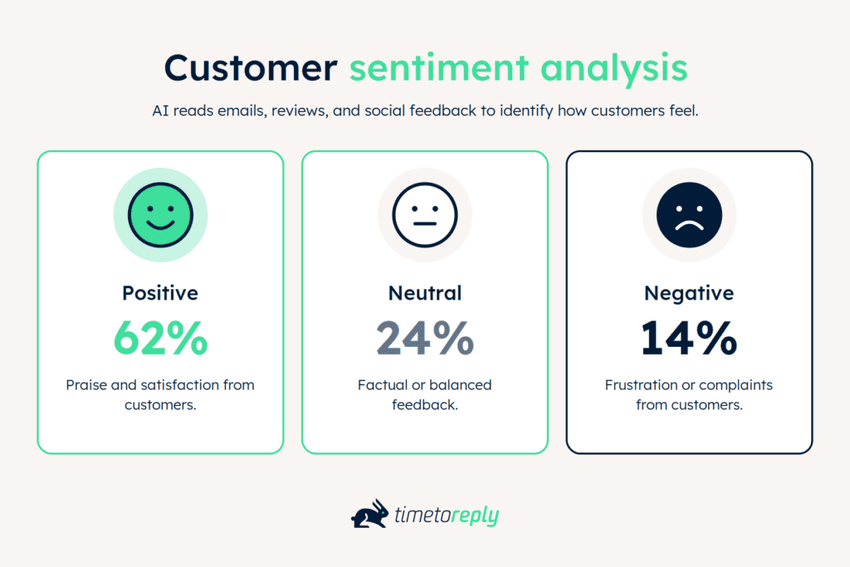
More advanced tools can also flag emotions, topics, and intent. This gives you more context about the customer experience than scores alone.
One message can contain two very different feelings. A client may praise your product in one line and complain about support in the next.
Customer sentiment analysis helps you spot these mixed signals across many conversations. It also reveals wider trends without requiring you to request customer feedback.
That matters because customers don’t always share feedback directly. Qualtrics studied more than 23,000 consumers for its 2025 report. It found that 32% of buyers sent feedback directly to the brand after a negative experience.
Even so, 22% shared a comment or rating on a review site. Another 16% posted something about the issue on social media.

Image via Qualtrics
These findings show why you need more than survey scores. Customer sentiment analysis helps you understand the attitudes behind those numbers.
Customer sentiment analysis reveals buyers’ attitudes towards your business by studying what they write. AI tools scan customer messages to find emotional cues. They then group these feelings into clear positive, negative, or neutral categories.
Also Read:
These metrics may overlap, but they track different parts of the customer experience. Customer sentiment analysis uncovers hidden emotions in text customers already wrote. CSAT, NPS, and CES collect customer feedback using survey questions.
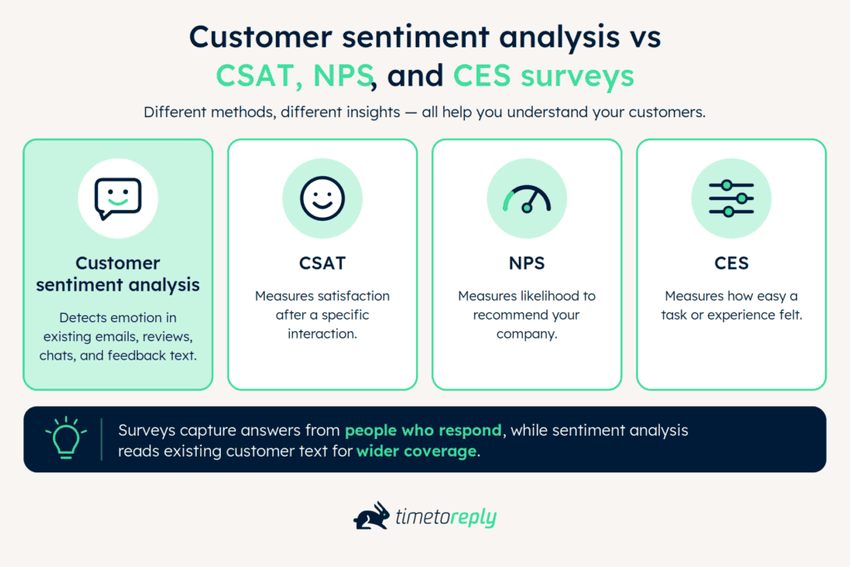
Here’s what each customer experience metric tracks:
Surveys only reach buyers who choose to respond, while customer sentiment analysis reads every message you receive. That gives you broader coverage.
Customer feedback sentiment analysis can also study survey comments. It explains why clients give certain scores.
Even so, neither method replaces the other. A score alone may not show the full picture of customer satisfaction.
Yes. CSAT, NPS, and CES surveys ask buyers to rate their experience directly. Customer sentiment analysis examines what they already say, without asking. Clients may skip surveys but still share feelings in emails, chats, or reviews. You can use all four for a clearer view of customers.
Also Read:
Customer sentiment analysis converts buyer messages into useful structured data. It then compares that data against patterns learned by modern algorithms.
Most modern tools rely on machine learning rather than simple keyword lists. The exact models may differ, but the basic process stays the same:
Here’s how the full customer sentiment analysis process works step by step:

The second and third steps highly influence accuracy. The last two turn those results into useful insights.
Preprocessing may seem simple, but it affects every step that comes next. Email makes this harder than live chat. One email can include the full thread from earlier replies. If the system reads that old text, it may give the wrong score during customer sentiment analysis.
For example, a customer may have complained three replies ago. Your customer service team may have fixed the issue since then. If the model reads the old complaint, it may still mark the thread as negative.
There are three common ways to build a customer sentiment analysis system. Rule-based tools follow set instructions, while machine learning and transformers learn from language examples. The trade-off comes down to things like cost, speed, accuracy, and how easy the system is to understand.
Here’s how the three approaches differ.
The best fit comes down to your team’s needs. Simple, rule-based systems can work well for smaller teams. A larger customer support team may need models that understand context better.
Either way, customer sentiment analysis works best when you check its results. A high score means little if the model reads the wrong message.
Most customer sentiment analysis systems follow five basic stages. First, the platform pulls messages from your channels and removes unnecessary content. Next, it turns the text into data that the model can understand. Finally, the model classifies each message by sentiment and combines results to reveal trends.
Also Read:
Customer sentiment analysis matters because it turns conversations into measurable signals. It helps teams identify customer concerns, find churn risks, and improve satisfaction.
Here are the main perks of customer sentiment analysis:
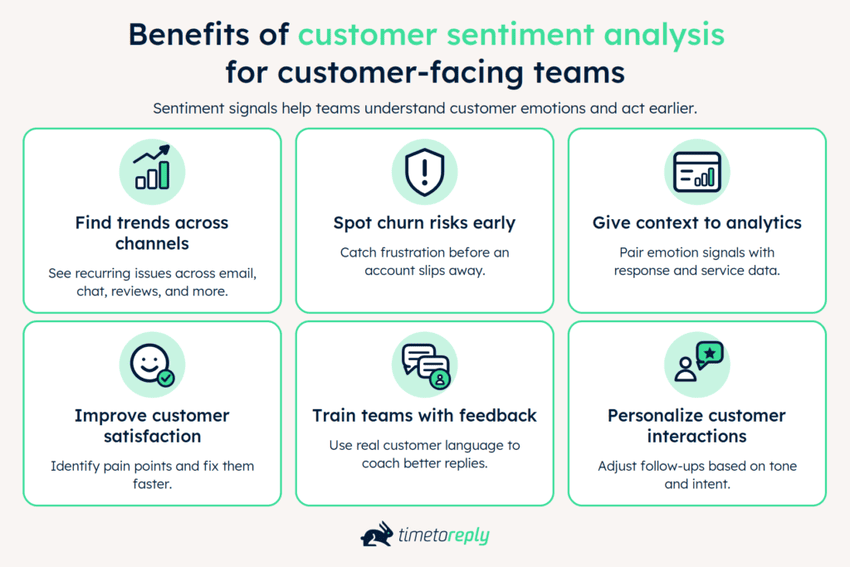
Your existing customer experience analytics can miss important context. Customer sentiment analysis closes that gap. It can show which products, channels, or steps create poor experiences.
Buyers also want you to remember your past chats with them. A recent 2026 study from Zendesk proves this point. It found that 67% of customers expect brands to match support to past conversations. On top of that, 74% feel frustrated when they have to repeat information.
Customer sentiment analysis doesn’t replace operational metrics. Instead, it works alongside them. Email analytics already show how much insight teams miss without context.
Telarus used email analytics to track team performance. Kyra Augustus reports that some groups cut response times from 7 to 2 hours.

Image via timetoreply
That result shows the value of tracking email communication to improve team efficiency. It doesn’t measure customer sentiment itself.
Shannon Sylva is the Chief Experience Officer at Hit Promotional Products. In this timetoreply case study, she links some organic growth to timetoreply’s email analytics software. Even so, she notes that it works alongside other customer experience solutions.
These examples give you an important lesson. Better buyer data can improve team productivity and workflows. Customer sentiment analysis adds context, emotion, and history to that data.
It helps teams understand the why behind customer behavior. Your existing metrics show what happened. Customer sentiment analysis reveals how clients felt about it. The insights help you find recurring problems, reduce churn, and improve satisfaction. They also guide team coaching.
Also Read:
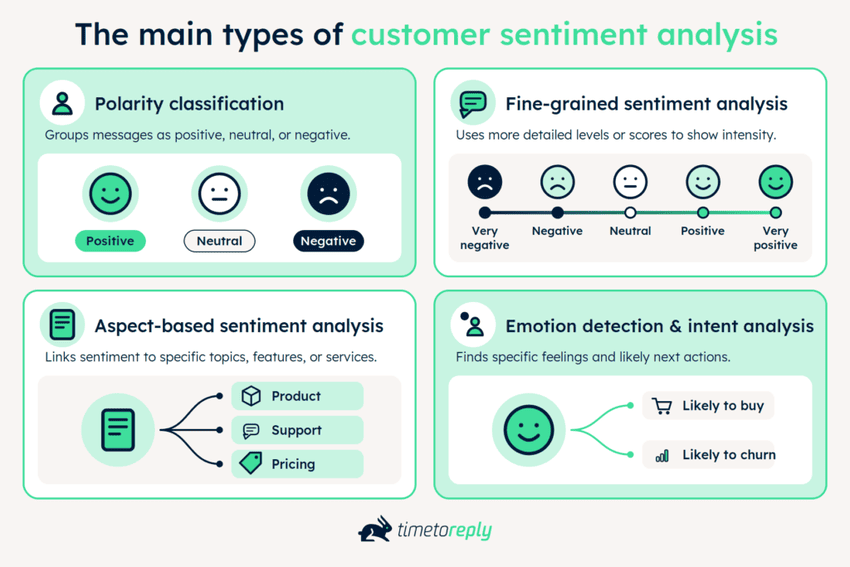
Customer sentiment analysis tools process text in different ways. You can choose between four main types. They include polarity classification, fine-grained scoring, aspect-based tracking, plus emotion and intent detection.
Some systems tell you the overall mood in customer feedback. Others explain the reason behind it or identify a specific emotion. Advanced models even predict what a customer may do next.
Review these options carefully before deciding.
This approach is also called standard customer sentiment analysis. It gives you a broad view of buyer opinions. Your software scans customer emails and messages and places them into three groups:
This method works well when you need to scan large volumes of messages. You can quickly flag positive and negative trends across channels.
The catch is limited detail. A negative message could mention price, support, quality, or delivery. Standard customer sentiment analysis doesn’t always show what caused the frustration.
Fine-grained customer sentiment analysis gives you more detail than basic polarity. Instead of three labels, you can use several levels.
For example, you might use:
You can also use a numerical scale. A score might range from 1 to 5 or -1 to +1.
This approach helps you spot changes in customer satisfaction before they cost you. It also separates mild complaints from serious ones. Your support team can then focus on buyers who need immediate help.
For example, “The wait was a little long” shows mild frustration. “I have waited three weeks for help” shows much stronger dissatisfaction.
Also Read:
Aspect-based customer sentiment analysis (ABSA) links emotions to specific features, topics, or services. It breaks sentences apart to show exactly what the buyer is talking about.
Here’s an example of what a customer might write. “The software design is great, but the customer support is terribly slow.”
Aspect-based tools mark the design as positive. They then score the support speed as negative. This prevents one bad experience from masking a feature that users actually love.
A 2026 report from Sistemasi shows how ABSA continues to gain traction. The review notes that research on the model is growing by over 30% each year. That’s because more brands want deeper customer insights tied to specific aspects.
Customer sentiment can tell you whether feedback is broadly positive or negative. Emotion detection gives you more detail by picking up specific feelings like anger, worry, frustration, and more.
That matters because a happy sounding customer can still have doubts or concerns. That’s where intent analysis closes the gap and takes things one step further.
Intent analysis looks at what the customer plans to do next. That could mean canceling a subscription, reporting a problem, or buying again.
Emotion detection and intent signals often appear alongside customer sentiment analysis, but they’re not the same thing. Each one answers a different question:
You can combine them to spot frustration or churn signals early. This helps your team fix issues and improve customer experience before buyers leave.
The main types are polarity classification, fine-grained analysis, and aspect-based analysis. Emotion and intent analysis also earn a spot. Each method answers a different question about customer feedback. Choose the level that matches your goals, data, and team needs.
Also Read:
Customer sentiment analysis pulls text from many platforms where buyers express opinions. That includes support tickets, chats, call transcripts, and reviews. Social media posts, survey comments, and email also qualify.
Each source gives you a different view of customer feelings.
| Channel | Who writes it | Typical length | What the sentiment signal is good for | What it misses | Typical B2B volume |
| Customers, prospects, partners | Long, multi-topic | Detecting detailed complaints, churn risks, and account health | Silent accounts and issues solved by phone | High per account, low per person | |
| Live chat | Any user, often anonymous | Short, single-topic | Catching immediate frustration and reactions | Long-term relationship trends | Low |
| Phone or voice | Any user | Varies | Tracking tone, voice pitch, immediate anger | Needs transcription and leaves less written evidence | High, but rarely captured as text |
| Surveys (NPS/CSAT/CES) | Self-selecting respondents | Short, prompted | Comparing stated scores | Everyday natural conversations | A handful per account |
| Social media | Customers, followers, prospects | Short | Capturing public brand perception and viral product backlash | Private B2B relationships | Low |
| Online reviews | Motivated customers | Medium | Tracking public product feedback and brand reputation | Quiet customers | Low |
| Support tickets | Any user | Short to medium | Uncovering recurring product problems, complaints, and urgency | Wider relationship context | High |
Data compliance laws also vary across channels. Email faces strict privacy limits on tracking message content.
The UK Information Commissioner’s Office makes this clear. Its 2026 guide says reading email content directly is tough to justify. This applies where standard network data traffic can help you meet the same goal.
The richest B2B conversations often sit in your email. Despite this, most customer-facing teams leave it out of customer sentiment analysis. That leaves a huge blind spot in how you view your buyers.
Case studies highlight how heavily teams rely on email and why it’s overlooked:

Image via timetoreply
Email also brings technical challenges that can make customer sentiment analysis harder. A single thread can hold weeks of history that simple software may struggle to read. Shared team mailboxes can make tracking even harder.
Opt-in requirements add another limit. Reading private messages requires clear permission from your customers. You can’t just turn this on as a default setting.
Operational email analytics software can avoid reading message content entirely, which helps you meet privacy requirements. A tool like timetoreply focuses on email headers and metadata. It tracks email reply times, volume, and SLA targets without ever storing email text.
The platform also enforces strict security standards. These include SOC 2 Type II, ISO 27001, HIPAA, and GDPR.
To catch emotional cues safely, you can use relationship signals. Features like timetoreply’s Smart Data use AI to track these signals under strict security rules. It surfaces tone, intent, and urgency. This helps you flag service risks early without breaking customer trust.
It draws data from email, chat, calls, surveys, social media, reviews, and support tickets. Each channel captures different customer signals. Email often gives you the deepest B2B relationship signals. Yet many teams still treat it as an afterthought.
Also Read:
B2B customer sentiment analysis looks at sentiment across an entire account, not just one individual buyer. B2B teams must combine views from several contacts and deal with mixed opinions per account. They also work with fewer messages than B2C brands.
B2C customer analysis tools often struggle with these needs since they treat each person as a separate customer. For B2B teams, the goal is measuring account health across the entire relationship.
Here are the differences between B2B and B2C customer sentiment analysis:
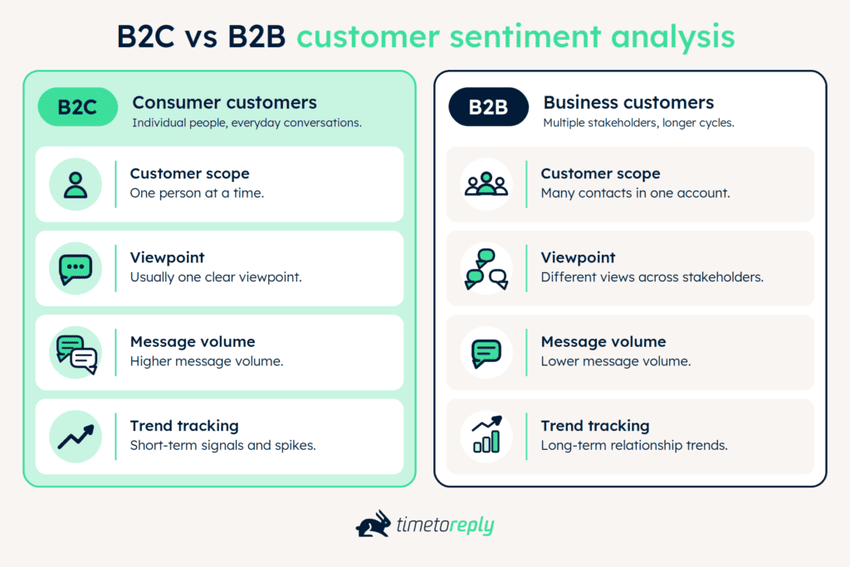
In B2C, a single person usually represents one customer. In B2B, one account can have many contacts who might not be on the same page.
A procurement lead may focus on costs and contracts. A daily user, by contrast, may care about product performance. An executive might focus on results and business value. An average sentiment score across their messages may hide these differences.
B2B buyers rarely use a single channel. McKinsey surveyed nearly 4,000 B2B decision-makers across 13 countries in 2026. It found that customers use an average of 10 channels during their buying journey.
That creates another challenge. Customer sentiment analysis may spread data across many channels and contacts. You need to connect those signals to the buyer account. This makes the data more useful. It’s the same as what customer success analytics does with other account signals.
Consumer brands process thousands of reviews each month. A B2B team might only exchange a few emails with a key account each quarter.
Small samples change how you should read customer sentiment analysis data. A slight score change might only reflect one unhappy message. Treating it as a trend creates a problem that doesn’t exist.
B2C customer sentiment analysis tools read patterns across countless messages. Even small shifts can signal changes in the customer experience.
For B2B teams, tracking weekly percentage changes creates false alarms. With smaller message volumes, patterns show up over time. So, look for trends across months or quarters instead.
In a 2023 G2 review, Dane S., a small-business owner, gave timetoreply a 4.5 out of 5 rating. The platform helped him spot key account details after comparing two suppliers.
He noted that one vendor responded within 45 minutes on average. The other took 6.5 hours. Their SLA breach rates were 5% versus more than 50%. Seeing the full account history explained performance better than a simple score.
The lesson is simple. Sample size changes what your customer sentiment analysis score can tell you.
B2C analysis focuses on individual customers. B2B customer sentiment analysis tracks account health across the entire relationship. One account may have many contacts, each with different needs. B2B teams also work with less data than consumer brands.
Also Read:
You measure customer sentiment by running customer sentiment analysis software across individual messages. The software then converts those text labels into a numerical score.
There’s no single industry standard to compare against. So, track your score against your own historical data.
Here’s a simple customer sentiment analysis process you can use:
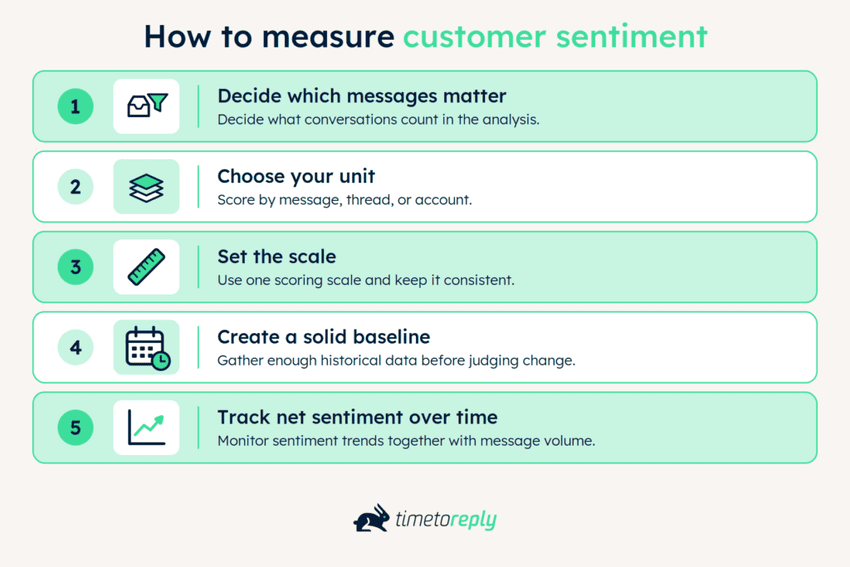
First, determine which conversations to review. Will you score inbound messages only or your email replies as well? Set this clear rule before anything else. Then, stick to it each time.
Next, decide what you want each score to represent. You can score a message, thread, or account.
Each option delivers a very different perspective on account health. Message scores give you detail while account scores offer a wider view.
Pick one numerical scale and stick with it permanently. Changing your scoring rules midway through will mess up your historical reporting.
You may come across various types of customer sentiment analysis scales. Unlike email response time, these scales don’t share one common reference unit. Each one may also use different scoring methods, making direct comparison hard.
Here is how several common published scoring scales compare:
| System | Scale as published | Neutral band | What “positive” means on it | Comparable with the others? |
| Microsoft Dynamics 365 | −5 to +5 | −1 to +1 | +2 and above | No |
| Google Cloud Natural Language | −1 to +1 | 0 | Above 0 | No |
| Qualtrics Text iQ | −2 to +2 | 0 | +1 and above | No |
| Oracle Text | −100 to +100 | -50 to +50 | +50 to +80 | No |
Microsoft’s Dynamics 365 is one example that openly publishes its scoring bands. It uses a −5 to +5 scale for negative, neutral, and positive sentiment.
The same page explains the model’s limits. It uses public data from social media, retail, restaurants, consumer products, and automotive sources.
That data may not match your brand. For example, an industrial supplier uses a very different language than a retail shopper.
The same model only reads the first 128 words of a comment. It also supports English only.
Many B2B emails exceed 128 words due to long threads and detailed requests. So, comparing your customer sentiment analysis score with another company’s can mislead you.
The same sentiment score can mean two entirely different things on different scales.
Also Read:
Run your customer sentiment analysis model for a quarter before recording any changes. This gives you a fair starting point to measure future progress. Track the same channels and message types for the entire period.
Net sentiment shows the share of positive messages minus the share of negative messages. You report the result as a percentage. It’s a useful customer sentiment analysis metric that’s easy to understand.
You can calculate it from your message counts. That makes it easier to check than a private scoring system.
Here’s how to do it:
| Net sentiment = positive message share − negative message share |
Let’s say 60% of messages show positive sentiment. Another 25% show negative sentiment. Your net sentiment would equal +35%.
It also shows when small samples create unstable results. A net sentiment of −20% across 8 messages means little. The same result across 800 messages tells a different story.
So, always track sentiment and volume together. One without the other can give you the wrong picture.
There is no standard customer sentiment analysis scale. Start by choosing the messages you want to analyze. Then choose one sentiment scale and keep it consistent across your reporting period. Build a baseline before you judge any changes. Finally, track net sentiment, volume, and trends over time.
Also Read:
You can start customer sentiment analysis without buying new software right away. The first three steps are manual on purpose. They decide whether the final automated steps will produce results you can trust.
Here’s the step-by-step process of running customer sentiment analysis:
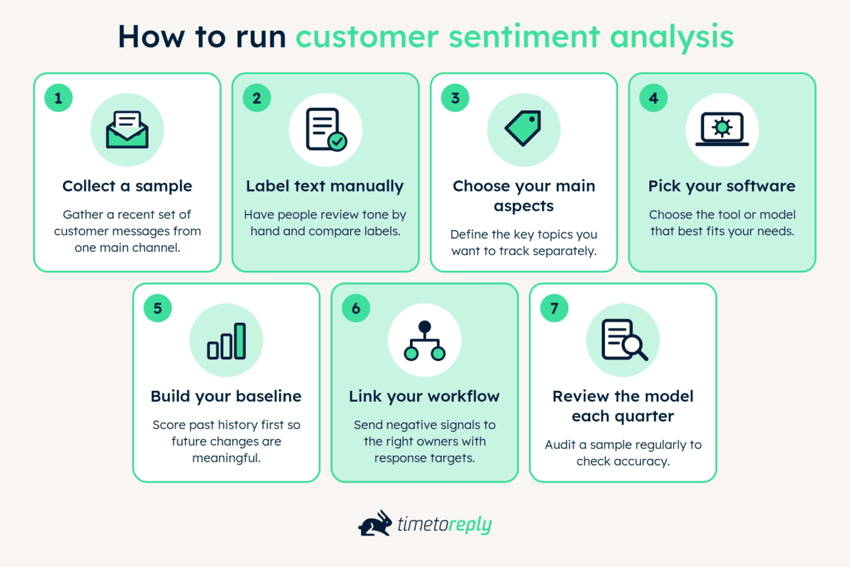
Automation removes tedious manual tasks, but it doesn’t replace human judgment. Customer sentiment analysis still needs clear rules and regular checks to ensure accuracy.
Muve previously used manual processes to track customer service resolution. Suren Nanayakkara, the ICT Director at Muve, describes how the team automated manual tasks with timetoreply. These included data capture, SLA tracking, and reporting.
Ontellus also tracked email responsiveness before setting a target. Lonnie Jackson, Vice President of Customer Management, reported the result. The share of emails answered within eight business hours rose from 62% to 86%.
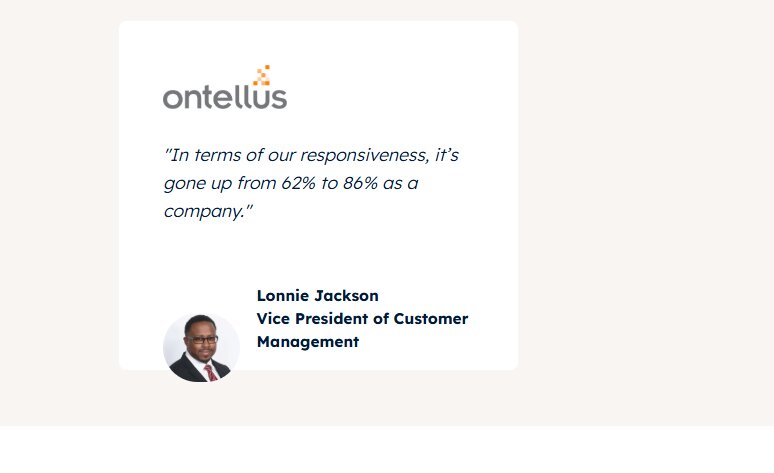
Image via timetoreply
The same idea works for customer sentiment analysis. First, set your baseline, choose your target, then track the change.
Start with a small sample of real messages, label them by hand, and agree on clear sentiment rules. Then define your key aspects, test an analysis method, and build a baseline. Finally, connect important insights to your support workflows and review the scores each quarter.
Also Read:
Customer sentiment analysis is accurate enough to provide useful results. Even so, you should never trust a model blindly without verifying its outputs. AI models work well on simple text, but harder language can reduce accuracy.
Few vendors publish their real accuracy data, so ask for proof before buying. Look for tests that match your language, channels, and use case.
People don’t always agree on sentiment. A peer-reviewed PLOS ONE study shows why. Researchers asked 106 native English speakers to label 252 unclear sentences.
A 1.0 score means everyone agreed completely, while a 0.0 means their agreement was random guessing. The native speakers scored 0.50 to 0.59 under two sets of instructions.
That doesn’t mean people got 50% or 59% of labels right. The score also accounts for agreement that could happen by chance.
The study used difficult examples on purpose. Normal customer service emails may produce stronger agreement.
Still, the lesson matters. If humans disagree about tricky examples, software models cannot promise 100% accuracy.
Three common factors can confuse customer sentiment analysis models:
A simple model may force mixed customer feedback into one label. That can hide useful details. Aspect-based customer sentiment analysis can help, as it links sentiment to specific topics. For example, a buyer may praise support but dislike pricing.
Implied sentiment creates an even bigger customer service challenge. A client can express a feeling without using obvious positive or negative words.
A 2025 arXiv study compared stated and implied sentiment. The AI models scored 13 to 23 points lower on implied sentiment. This shows that most models struggle when customers hint at how they feel without saying it directly.
That gap matters in B2B. Take this message, for example. “We’ll need to discuss this at the renewal.” The sentence contains no clear negative word. Yet it may signal a serious problem.
So, a high benchmark score doesn’t prove that a model will work well for you.
Treat customer sentiment analysis validation as a routine task. Rather than only testing a model before buying, review it each quarter to ensure accuracy.
Use this simple process to review customer sentiment analysis software:

Also check new phrases and customer language as you introduce fresh products. Your model can lose accuracy as changes add up.
An audit can also reveal useful operational insights. Clear Skies Title Agency used email analytics to study reply patterns. Heather Bryant said the team’s response time was on target. Even so, the review uncovered a staffing pattern the team hadn’t noticed.
Yes, customer sentiment analysis is accurate enough to spot trends across messages. However, some models struggle with sarcasm, negation, and mixed sentiment. Running quarterly human checks helps you keep your data accurate.
Also Read:
1. Can ChatGPT do sentiment analysis?
Yes, but it has limits. ChatGPT can classify sentiment without special training. That makes it quick to test. Benchmarks show weaker results on aspect-based tasks. Fine-tuned models score about 69 micro-F1, while LLMs score around 50. Use them to test the idea, not as your first model choice.
2. Are there free customer sentiment analysis tools?
Yes, many platforms offer free tiers for customer sentiment analysis. Free tiers work well for testing small message volumes but only offer basic features. For advanced capabilities, you need to upgrade to paid plans, which can get expensive with higher message volumes.
3. Can you give an example of customer sentiment analysis?
Say a customer praises onboarding but complains about billing. A basic tool may label the whole message neutral. Aspect-based customer sentiment analysis marks onboarding as positive and billing as negative. That second view helps you route and fix the issue quickly.
4. What should you look for in a sentiment analysis tool?
Rather than checking features alone, check whether a solution:
5. What is sentiment analysis in customer service?
Customer sentiment analysis uses text from tickets, chats, and emails to classify emotions. Teams use it to flag unhappy customers and find common service issues. You can also use it to coach your team by showing where customers struggle and what drives negative sentiment.
6. What is consumer sentiment, and how is it different from customer sentiment?
These terms mean very different things. Consumer sentiment measures how households feel about the economy. Customer sentiment shows how clients feel about your company. Both appear in reports and research. Always check the source before using one figure for the other.
7. Can you run customer sentiment analysis on email?
Yes. Email gives you rich customer data, but it needs care. Threads include old replies, signatures, and disclaimers. Long emails can also hit model limits. Content scanning raises data privacy concerns too. When handled well, email offers deep customer sentiment analysis data for B2B teams.
8. Is customer sentiment analysis the same as CSAT or NPS?
No. CSAT and NPS ask customers to give a score. Customer sentiment analysis infers feelings from text they already wrote. Surveys give you numbers, but sentiment analysis covers a wider range of feedback. You can run both. Surveys can help you check whether your customer sentiment analysis results make sense.
9. How much feedback do you need before customer sentiment analysis is meaningful?
No fixed volume works for every type of business. Small account samples can make trends hard to trust, so use more messages for stronger signals. For account-level decisions, read individual messages alongside the score. This helps you judge the customer sentiment analysis result more accurately.
Customer sentiment analysis shows how customers feel about your business. It helps you spot hidden frustration early and improve customer retention.
You can analyze emails, chats, reviews, surveys, calls, and social media. If you rely on email, start there. Your best B2B customer insights already sit in your inbox.
Build a clear baseline, assign an owner, and run checks each quarter. This helps you spot changes over time.
Want to see what your team’s email data already shows? Book a demo today.
Get live inbox alerts and reply quickly to customer emails with timetoreply

CEO @ timetoreply
Howard Moodycliffe is CEO of timetoreply, an email analytics & relationship intelligence platform for B2B customer-facing teams. He writes about email performance, SLA management, and how organisations can use communication data to protect customer relationships and revenue.


Trusted by high-performing inbound sales teams and customer-facing teams globally.
Close more deals and delight more customers with the faster, smarter, deeper email analytics and performance optimization software that works straight from your team’s inbox.